
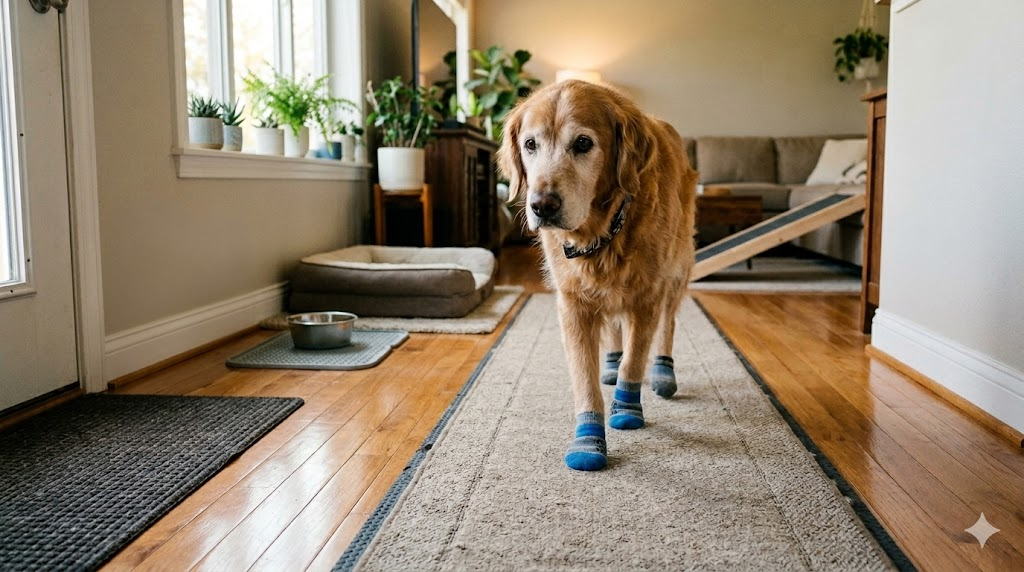
Most homes are not designed with aging dogs in mind. Hardwood floors, tile bathrooms, polished concrete, and open-plan layouts look beautiful to us and feel like an obstacle course to a senior dog with weakening legs and less reliable balance. The reassuring part is that you don’t need to renovate. A targeted checklist of practical, affordable changes can transform the same home into one your dog navigates with far more confidence and far fewer dangerous moments.
In this Guide
- 1 How to Use This Checklist
- 2 Zone 1: Sleeping and Rising Area
- 3 Zone 2: Main Travel Routes
- 4 Zone 3: Food and Water Station
- 5 Zone 4: Door Thresholds and Exit Points
- 6 Zone 5: Stairs and Ramps
- 7 Zone 6: Furniture Access and Landing Zones
- 8 Zone 7: Bathroom and Wet Areas
- 9 Zone 8: Paw Condition
- 10 Quick-Reference Priority Order
How to Use This Checklist
Work through each zone in your home rather than trying to address everything at once. Prioritize the areas your dog uses most frequently and the spots where slips have already happened. A near-miss or actual fall is your clearest signal that a zone needs attention first.
Zone 1: Sleeping and Rising Area
Rising from rest is one of the highest-risk moments for a senior dog. All four legs must coordinate to push the body up, often from a cold-start after hours of stillness.
- ☐ Is the bed sitting on a rug or non-slip mat that extends at least 60–90 cm in every direction? If not, even perfect footing on the bed surface doesn’t help when their paws hit bare floor on the way up.
- ☐ Is the bed itself supportive enough that rising doesn’t require an extra “scramble”? A bed that sinks deeply or slides on the floor makes standing harder and increases slip risk.
- ☐ Is there enough clearance around the bed for your dog to stand and turn without immediately stepping onto a slippery surface?
- ☐ Is the sleeping area away from drafts or cold vents? Cold makes muscles stiffer, and a stiff dog rises more awkwardly.
Zone 2: Main Travel Routes
Map the three or four paths your dog takes most: bed to door, kitchen to living room, between floors if they use stairs. These routes deserve continuous traction, not patchy coverage.
- ☐ Are there non-slip runners or rugs covering the full length of main hallways, with no gap of bare floor larger than about 60 cm?
- ☐ Do all rugs have rubber-backed or non-slip pad support underneath? A rug that slides is more dangerous than bare floor because it moves unexpectedly underfoot.
- ☐ Are rug edges flat and secured? Curling or thick beveled edges catch dragging paws—use rug tape or tacks on any edge that lifts.
- ☐ Is there continuous traction at corners or turns in the route? Dogs often slip when changing direction, not just when walking straight.
Zone 3: Food and Water Station
Dogs shift their weight forward and stand for several minutes while eating and drinking. On slippery floors, this sustained standing creates fatigue and micro-slips they may not recover from gracefully.
- ☐ Is a non-slip mat placed under both the food and water bowls, large enough that all four paws can stand on it simultaneously?
- ☐ Is the mat textured on top—not just non-slip on the bottom—so paws actually grip it? Bath mats and anti-fatigue kitchen mats often work well here.
- ☐ If your dog uses raised feeders, is the stand stable and weighted enough not to slide when they lean into it?
- ☐ Is water being cleaned up promptly? A wet floor around the water bowl becomes a slip hazard within minutes, especially if your dog splashes.
Zone 4: Door Thresholds and Exit Points
The back door, front door, and any exterior exit are high-excitement zones where dogs move fast—exactly when slips happen. Add traction before a rush becomes a fall.
- ☐ Is there a non-slip mat directly inside each door your dog uses regularly, large enough for all four paws to land on when coming in?
- ☐ Is there a mat or rug outside the door on the deck, step, or patio where they wait or land? Wet decking, painted concrete, and composite decking can be extremely slippery.
- ☐ Are door thresholds (the metal strip between flooring types) low-profile and smooth? A raised threshold is a trip hazard for a dog who shuffles their feet.
- ☐ In wet weather, is there a plan for drying wet paws before your dog runs across the house? A wet paw on hardwood is significantly more slippery than a dry one.
Zone 5: Stairs and Ramps
Stairs combine height, momentum, and required foot placement precision—a challenging combination for senior dogs.
- ☐ Do indoor stairs have non-slip treads on every step, covering the full width of the tread?
- ☐ Is there a baby gate at the top and bottom if your dog uses stairs unsupervised? Unsupervised rushing on stairs is one of the most common causes of serious falls.
- ☐ Is there a non-slip mat or rug at the bottom of the stairs where your dog lands?
- ☐ If a ramp is in use, is it secured against sliding at both the top and base?
- ☐ Is the ramp surface still providing good grip, or has it worn smooth? Check grip surfaces every 4–6 weeks.
Zone 6: Furniture Access and Landing Zones
Every jump up to and down from furniture creates a landing impact. Multiply that by six to ten times a day and it becomes a significant cumulative load on arthritic joints.
- ☐ Is a ramp or step set in place at each piece of furniture your dog accesses, with traction on the ramp surface and the floor beneath it?
- ☐ Are “jump-off spots” blocked so your dog routes through the ramp rather than jumping directly?
- ☐ Is there a rug at the base of the sofa or bed to absorb any unplanned landings?
Zone 7: Bathroom and Wet Areas
Tile bathrooms are among the most slippery surfaces in any home, and most dogs visit them at least for grooming or occasional bathing.
- ☐ Is there a non-slip bath mat outside the tub or shower that stays in place when wet?
- ☐ If your dog is bathed in a tub, is there a non-slip mat inside the tub itself? A frightened, wet senior dog scrambling on a slippery tub surface can injure themselves badly.
- ☐ Is the bathroom floor kept dry, or at minimum, is a mat placed on it whenever your dog is likely to enter?
Zone 8: Paw Condition
Even perfect flooring provides less grip if your dog’s paws aren’t in good condition. Paw maintenance is part of the floor-safety equation.
- ☐ Are nails trimmed short enough that pads—not nails—are making primary contact with the floor? Overgrown nails push paws into a “plantar-flexed” position that reduces pad contact.
- ☐ Is the fur between toe pads kept trimmed? Overgrown interdigital fur acts like socks on a smooth floor—and wet interdigital fur is even more slippery.
- ☐ Are paw pads healthy—no cracking, peeling, or overly smooth pads that provide less friction? Dry, cracked pads can be treated with paw balm that also marginally improves grip.
- ☐ If your dog still slips despite good flooring and healthy paws, have non-slip socks or paw wax available for the worst surfaces.
Quick-Reference Priority Order
If you’re starting from scratch and can’t address everything at once, tackle in this order:
- 1. Sleep/rise area and main travel route to the back door.
- 2. Stairs and ramp security.
- 3. Food and water station mat.
- 4. Door thresholds and exit zones.
- 5. Furniture ramps and landing zones.
- 6. Bathroom and wet area mats.
- 7. Paw condition maintenance.
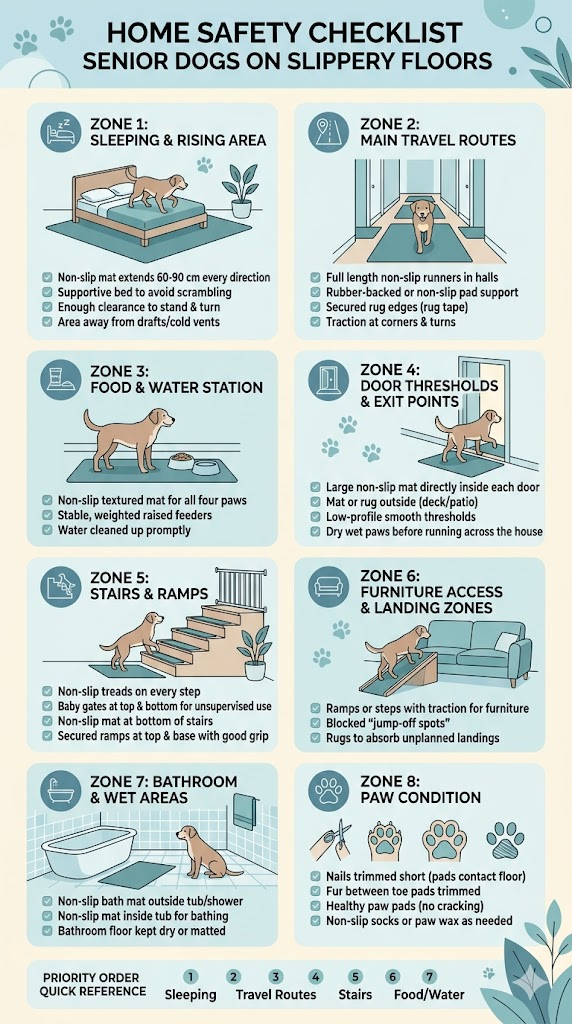
Run through this checklist every three to four months; what was adequate last winter may need updating as your dog’s mobility changes. The goal is a home where your senior dog moves with the same ease they used to—just with a little quiet help built into the floor beneath their feet.