
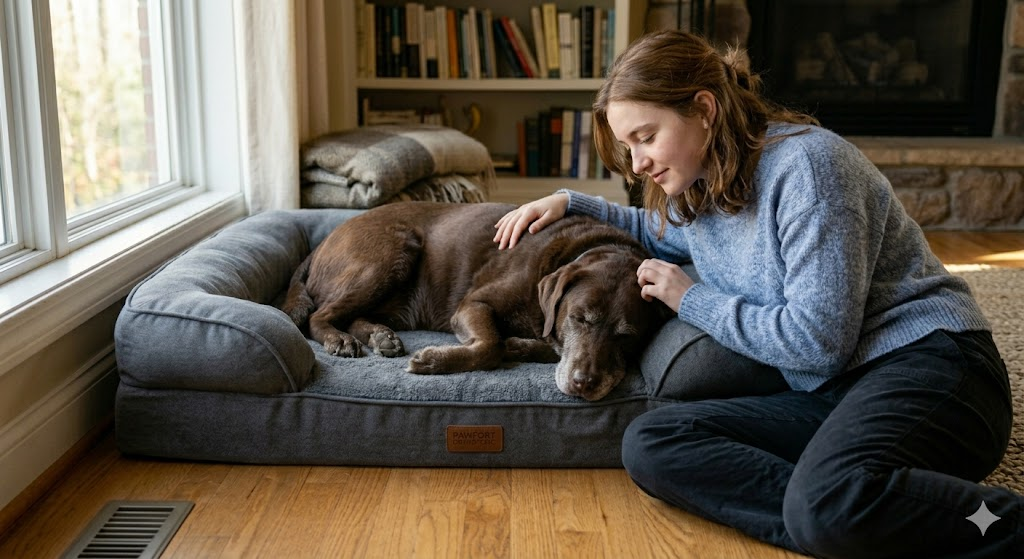
A large arthritic dog sleeping on a thin bed, a folded blanket, or bare floor is a dog waking up stiffer and more painful than they need to be. Sleep is when the body is supposed to recover—but for a big dog with inflamed joints, a poor sleeping surface can undo the benefit of medication, exercise, and all the other things you’re doing right. Choosing the right orthopedic bed for a large breed is one of the highest-impact, lowest-effort changes you can make for their daily comfort.
In this Guide
- 1 Why Regular Beds Fail Large Arthritic Dogs
- 2 What “Orthopedic” Actually Means (and What It Doesn’t)
- 3 Memory Foam vs. Supportive Base Foam: Which Is Better?
- 4 Size Matters More Than You Think
- 5 Entry Height: Getting In and Out Without Pain
- 6 Cover Material: Overlooked but Important
- 7 Placement: Where the Bed Goes Changes How Much It Helps
- 8 Signs Your Current Bed Isn’t Working
Why Regular Beds Fail Large Arthritic Dogs
Most standard pet beds are built around aesthetics and price, not therapeutic support. For large senior dogs, this matters more than it does for smaller or younger dogs.
- Bottoming out: A 35 kg dog lying on 5 cm of low-density foam compresses straight through to the hard base. At that point, they might as well be on the floor.
- Pressure concentration: Without proper foam support, body weight concentrates on bony prominences—hips, shoulders, elbows—causing pressure sores and increased pain at existing arthritic sites.
- Cold transfer: Thin beds on hard floors conduct cold directly into already-stiff joints, worsening morning soreness significantly.
A truly orthopedic bed counters all three of these problems simultaneously, which is why the difference between a cheap filled bed and a quality memory foam option is immediately visible in how your dog moves the morning after their first night on it.
What “Orthopedic” Actually Means (and What It Doesn’t)
The word “orthopedic” is not regulated in the pet industry—any manufacturer can put it on a label. When evaluating claims, focus on these specifics instead.
- Foam density: For a large breed, you need at least 4–5 lb/ft³ density foam. Lower density foam feels soft initially but compresses too easily under heavy weight. Ask the manufacturer or check the product specs, not just the marketing copy.
- Total foam depth: Aim for at least 10–12 cm total foam depth for dogs over 25 kg. A 7 cm bed may work for a 15 kg dog but will bottom out under a 40 kg one.
- Foam type: Standard memory foam contours to pressure and distributes weight well. Some beds use egg-crate foam (the wavy, textured kind) on top of a base layer—this can add comfort but egg-crate alone isn’t sufficient.
Memory Foam vs. Supportive Base Foam: Which Is Better?
Pure memory foam and layered foam designs each have real advantages for arthritic large breeds.
Pure Memory Foam
- Conforms precisely to body contours, distributing weight evenly across the entire lying surface.
- Eliminates pressure points at hips, shoulders, and elbows—the spots that get sore first in arthritic dogs.
- Can feel warm, which may be uncomfortable in summer for large double-coated breeds.
- Best for: dogs with multiple joint sites affected, dogs who sleep curled or in unusual positions, dogs with pressure sores or calluses.
[Insert Amazon Affiliate Link Here]
Layered Foam (Base + Memory or CertiPUR Foam)
- A firm base layer prevents bottoming out while a softer top layer provides comfort—the best of both worlds.
- Often more durable than pure memory foam under very heavy dogs, because the base layer maintains its structure longer.
- Best for: dogs over 35 kg, dogs who put weight on the bed suddenly (plopping down), dogs who need the stability of a firm edge to push off from when rising.
[Insert Amazon Affiliate Link Here]
Size Matters More Than You Think
Many owners buy beds that are just large enough for their dog to curl up—but arthritic dogs need more room, not less.
- Arthritic dogs often can’t comfortably curl tight anymore and tend to sprawl or lie in extended positions to reduce joint pressure.
- Measure your dog lying fully stretched on their side—length from nose to tail and shoulder width at the widest point—and add 30 cm to each dimension as a minimum bed size.
- A bed where your dog’s legs hang off the edge, or where they have to tuck unnaturally to fit, is defeating the purpose of the support.
For giant breeds—Great Danes, Mastiffs, Newfoundlands—look specifically for XXL orthopedic beds with weight ratings at or above your dog’s weight, not “up to” it. [Insert Amazon Affiliate Link Here]
Entry Height: Getting In and Out Without Pain
A bed that provides great support but is difficult to enter or exit is counterproductive. For arthritic large breeds, the sides and entry point matter as much as the foam itself.
- Flat/no-sided beds: Best for dogs with severe hip or hind-leg weakness; no barrier to step over, easy approach from any angle.
- Low-bolstered beds with one open side: The bolster provides a chin rest and psychological security without requiring your dog to step over a wall.
- High-walled bolster beds: Often beautiful but poorly suited to arthritic dogs who need to swing a stiff leg over to enter. These belong on the shelf.
If your dog already hesitates before lying down or circles repeatedly before committing, that’s often a sign the entry geometry of their current bed is uncomfortable for their specific joint limitations.
Cover Material: Overlooked but Important
The outer cover affects both comfort and practical maintenance for senior dogs, who are more likely to drool, lose bladder control, or shed heavily.
- Waterproof inner liner: Essential for any senior dog with even occasional incontinence. Without it, urine soaks into foam within seconds and is nearly impossible to fully clean out, creating odor and bacterial buildup. [Insert Amazon Affiliate Link Here]
- Removable, machine-washable outer cover: You’ll be washing this regularly. Make sure the zipper is durable and the fabric holds up to repeated washing without shrinking tight over the foam.
- Soft top surface: Microsuede and similar soft materials are kind to dogs with thinning coats or skin sensitivity; rough canvas-style covers can abrade elbows and pressure points over time.
Placement: Where the Bed Goes Changes How Much It Helps
The best bed in the wrong location won’t get used the way it should.
- Place the bed where your dog already naturally chooses to rest—near a wall or corner for security, close to where the family spends time, away from drafts and cold exterior walls.
- Put the bed on a non-slip rug or mat so it doesn’t slide when your dog steps on it or pushes off from the edge. [Insert Amazon Affiliate Link Here]
- Avoid placing orthopedic beds directly in front of heating vents; memory foam can trap and intensify heat, which becomes uncomfortable during long sleep periods.
- In multi-dog households, give the senior their own dedicated bed in a low-traffic area so they’re not jostled or forced to move constantly.
Signs Your Current Bed Isn’t Working
These are the signals that a bed upgrade should be a priority, not a luxury:
- Your dog chooses to sleep on the tile, floor, or a hard surface instead of their bed—often a sign the bed offers no real advantage over the floor in terms of pressure relief.
- Calluses forming or worsening on elbows and hocks, indicating repeated pressure on bony points.
- Increased stiffness and slow warm-up period after sleep compared to after activity.
- Visible struggling to rise from the bed—pushing multiple times or needing help—when they can get up from other surfaces more easily.
A properly supportive orthopedic bed for a large arthritic dog isn’t just about where they sleep. It’s about what condition they wake up in—and how much mobility and comfort carries through the rest of their day.