
There’s a particular kind of heartbreak that comes with watching your dog — the one who once sprinted across the yard without a second thought — now hesitate at the bottom of the stairs. You can see the calculation happening behind their eyes: Can I make it up? Will it hurt? That moment is a turning point for many dog owners, and if you’re here, you’re already doing the most important thing: paying attention. The good news is that with some targeted home modifications, you can dramatically improve your senior dog’s mobility, reduce daily pain, and restore a sense of independence that every dog deserves.
In this Guide
- 1 Understanding Why Your Senior Dog Struggles at Home
- 2 Flooring: The Silent Source of Stress and Injury
- 3 Stair Management: Keeping Every Level Accessible
- 4 Creating the Perfect Senior Dog Comfort Zone
- 5 Feeding and Water Stations: Small Adjustments, Big Relief
- 6 Senior-Safe Home Checklist
- 7 Movement, Exercise, and Knowing When to Rest
- 8 A Final Word
Understanding Why Your Senior Dog Struggles at Home
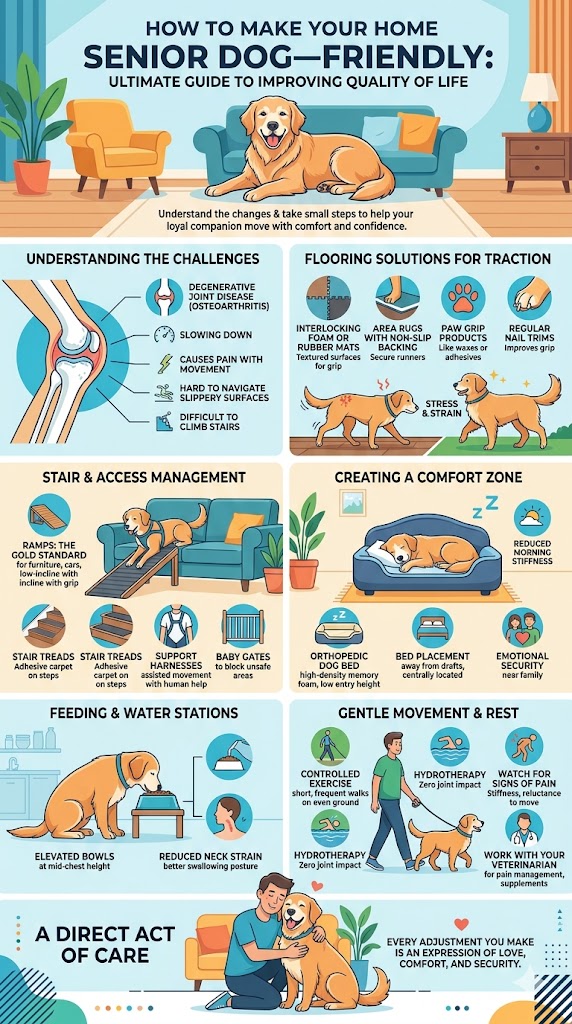
Before jumping into solutions, it helps to understand what’s happening physically. Most senior dogs — typically those over 7 years for large breeds, and 10+ for smaller ones — experience some degree of degenerative joint disease (DJD), commonly called osteoarthritis. Cartilage between joints gradually wears down, causing bone-on-bone friction, inflammation, and pain with movement. This isn’t just “slowing down with age.” It’s a chronic orthopedic condition that your home environment can either aggravate or actively support.
The three biggest home hazards for dogs with compromised dog joint health are slippery surfaces, elevation changes (stairs, furniture), and inadequate resting surfaces. Address these three areas and you will see a meaningful improvement in your dog’s confidence and comfort within days — not weeks.
Flooring: The Silent Source of Stress and Injury
Hardwood, tile, and laminate floors are among the most common causes of muscle strain and anxiety in senior dogs. When a dog can’t get traction, their muscles work overtime to compensate — even during a simple walk from the water bowl to their bed. Over time, this constant micro-compensation accelerates joint deterioration and causes visible stiffness, especially after rest.
Practical Flooring Solutions That Actually Work
- Interlocking foam or rubber mats: These are the fastest, most cost-effective solution. Lay them along the routes your dog travels most — hallway to kitchen, living room to back door. Look for mats with a textured surface rather than smooth foam for maximum grip.
- Area rugs with non-slip backing: A quality runner rug in a main corridor gives your dog a traction highway. Always pair rugs with a rubber underlay — a sliding rug is more dangerous than no rug at all.
- Paw grip products: For dogs resistant to booties, paw wax (like Musher’s Secret) or adhesive paw grips applied directly to the paw pads provide immediate traction on slick surfaces. These are especially useful between mat zones.
- Dog nail maintenance: Overgrown nails force the paw into an unnatural angle on hard floors, dramatically reducing grip. Regular trims are a non-negotiable part of senior dog mobility management.
When laying out your traction strategy, think in “pathways” rather than isolated spots. Your goal is to create a connected network of safe surfaces so your dog never has to hesitate mid-stride.
Stair Management: Keeping Every Level Accessible
Stairs are one of the most physically demanding challenges for a dog with joint pain. The ascending motion requires significant hip flexor engagement, while descending puts enormous concussive pressure on the front shoulders and elbows. For dogs with arthritis, a single staircase can represent a painful daily obstacle course.
Ramps: The Gold Standard for Senior Dog Accessibility
A well-chosen ramp eliminates the vertical impact of steps entirely. For furniture access (couch, bed), a low-incline ramp with a textured, non-slip surface lets your dog self-navigate without assistance. For outdoor stairs or vehicle access, longer ramps with side rails provide the safety margin your dog needs.
Stair Aids for When Ramps Aren’t Possible
- Stair treads: Adhesive carpet treads on each step provide traction and reduce slip risk significantly. They’re inexpensive and easy to install.
- Support harnesses: For dogs who must navigate stairs, a rear-support or full-body harness lets you provide a gentle lift under their hindquarters on the way up and controlled resistance on the way down. This is critical for preventing a fall-related injury.
- Baby gates as management tools: Sometimes the kindest intervention is blocking access to stairs your dog can no longer use safely and setting up a comfortable ground-floor living arrangement instead.
Creating the Perfect Senior Dog Comfort Zone
Where your dog sleeps and rests has an outsized impact on their joint health and overall quality of life. A dog sleeping on a thin, flat mat on a cold hardwood floor will wake up stiffer and more painful than one sleeping on a properly designed orthopedic surface. This is not a luxury upgrade — it’s a medical necessity for aging dogs.
Choosing the Right Orthopedic Dog Bed
True orthopedic dog beds use memory foam or high-density supportive foam — not just fiber fill marketed as “orthopedic.” The key is a foam density of at least 1.5 lbs per cubic foot, which provides genuine joint pressure relief rather than just a soft surface. Look for beds with a low entry height (under 4 inches) so your dog doesn’t have to step up and over a bolster to lie down. Waterproof inner liners are a practical must for senior dogs who may have occasional incontinence.
Bed Placement and Environment
- Place the bed away from cold drafts and air conditioning vents — cold temperatures worsen joint inflammation and morning stiffness.
- Position the bed in the room where your family spends the most time. Social isolation increases anxiety in senior dogs and can cause them to over-exert themselves trying to follow you from room to room.
- If your dog sleeps in your bedroom, a low-profile dog bed beside yours (rather than on the bed itself) eliminates the jumping risk while keeping them close and emotionally secure.
- Consider a self-warming orthopedic mat for dogs with severe arthritis — the gentle heat improves circulation and reduces morning stiffness noticeably.
Feeding and Water Stations: Small Adjustments, Big Relief
An often-overlooked aspect of improving quality of life for aging dogs is the physical strain of eating and drinking from floor-level bowls. For dogs with cervical (neck) arthritis or front-limb weakness, bending down repeatedly to a ground-level bowl causes real discomfort. Elevated food and water stations — positioned so the bowl sits at mid-chest height — reduce neck extension, improve swallowing posture, and make mealtime noticeably more comfortable.
Senior-Safe Home Checklist
Use this room-by-room checklist to audit your home and identify quick wins:
- ✅ Non-slip mats or rugs laid along all main traffic routes
- ✅ Rubber underlay beneath all area rugs
- ✅ Paw nails trimmed to appropriate length
- ✅ Ramp or low steps installed for furniture and vehicle access
- ✅ Stair treads applied to all indoor and outdoor stairs
- ✅ Support harness available for assisted navigation
- ✅ Orthopedic dog bed with low entry and foam support in primary rest area
- ✅ Bed placed away from cold drafts, in a socially central room
- ✅ Elevated food and water bowls at mid-chest height
- ✅ Baby gates used to restrict access to unsafe stairways
- ✅ Outdoor ground check — gravel or uneven terrain replaced or avoided on daily walks
Movement, Exercise, and Knowing When to Rest
Home modifications protect your dog from pain, but gentle, consistent movement is what maintains the muscle mass that supports their joints. The goal isn’t rest — it’s controlled activity. Short, frequent leash walks on even surfaces are significantly better for senior dog mobility than one long weekend outing. Hydrotherapy and swimming, where available, allow full range-of-motion exercise with zero joint impact and are considered the gold standard in canine orthopedic rehabilitation.
Watch for the signs that today calls for more rest: stiffness lasting more than 10 minutes after waking, reluctance to put weight on a limb, audible discomfort when lying down, or visible swelling around a joint. On these days, gentle warmth and reduced activity are the right call. Always work with your veterinarian to establish a pain management protocol — NSAIDs, joint supplements (glucosamine/chondroitin, omega-3s), and in some cases laser therapy or acupuncture can make a substantial difference alongside your home modifications.
A Final Word
Your senior dog doesn’t understand why their body feels different than it used to — but they do notice when moving through the world feels safer, easier, and less painful. Every ramp you install, every mat you lay down, every soft bed you provide is a direct act of care that your dog experiences as comfort and security. These changes don’t just improve their physical health; they protect the trust and confidence your dog places in their home and in you.
You don’t have to do everything at once. Start with the one or two changes that address your dog’s most pressing daily challenge — whether that’s the slippery kitchen floor or the staircase to your bedroom — and build from there. The difference will be visible, and it will be worth it.
Ready to go deeper? Visit our Knowledge Hub for detailed guides on support harnesses, ramp comparisons, orthopedic bed reviews, and everything else you need to keep your aging dog moving comfortably through every stage of their senior years. Your dog gave you their best years — now it’s your turn.