
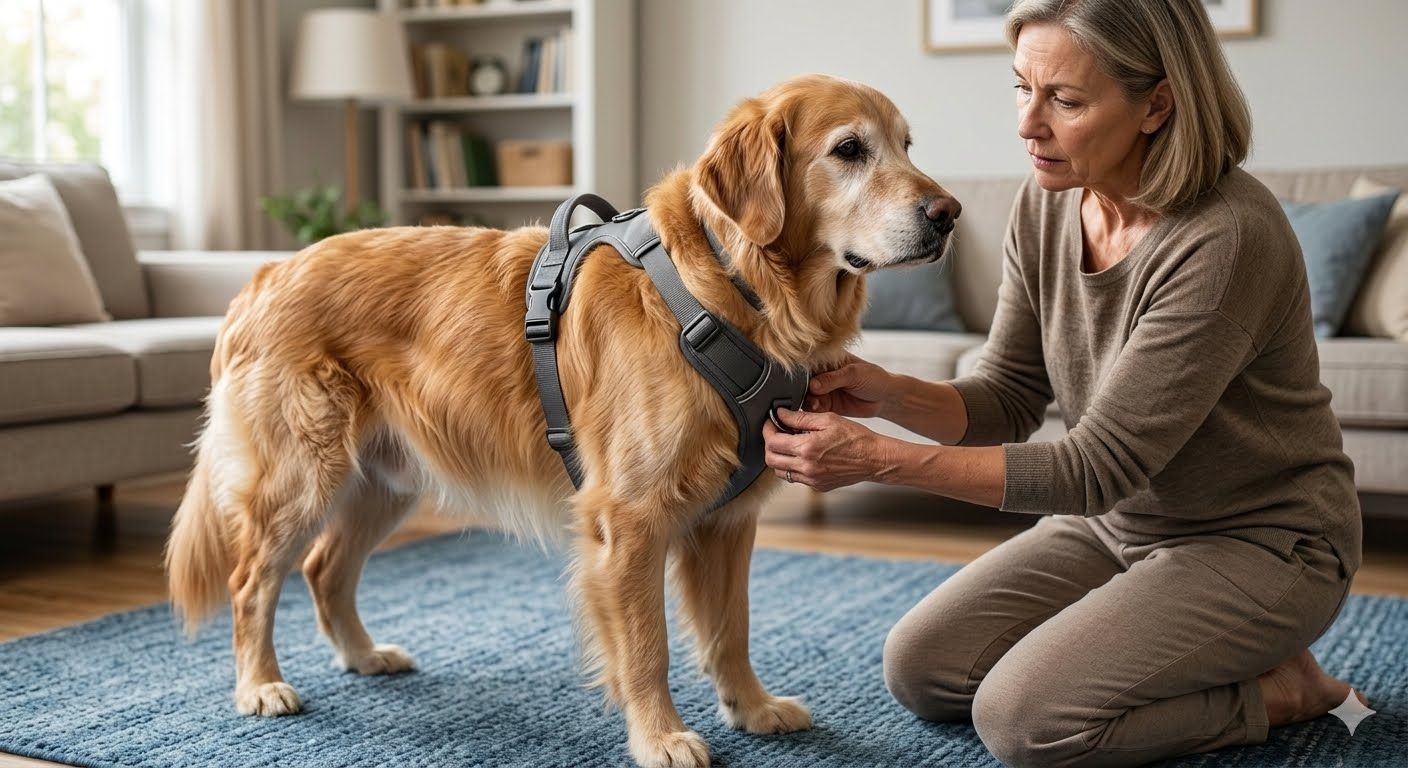
A well‑chosen harness can be one of the most powerful tools you have to support a senior dog with mobility issues. It can protect their neck, give you safe “handles” to assist, and help prevent falls. But as a canine rehabilitation specialist, I also see the other side: harnesses that are too tight, poorly placed, or used in the wrong way—adding pain instead of relieving it.
Many of these mistakes come from love, not neglect. You’re trying to help, but no one ever showed you exactly how that harness should sit on an arthritic, aging body. In this guide, we’ll walk through the most common harness fitting and usage errors I see in senior dogs—and how you can fix them quickly at home.
In this Guide
- 1 Why Harness Fit Matters More for Senior Dogs
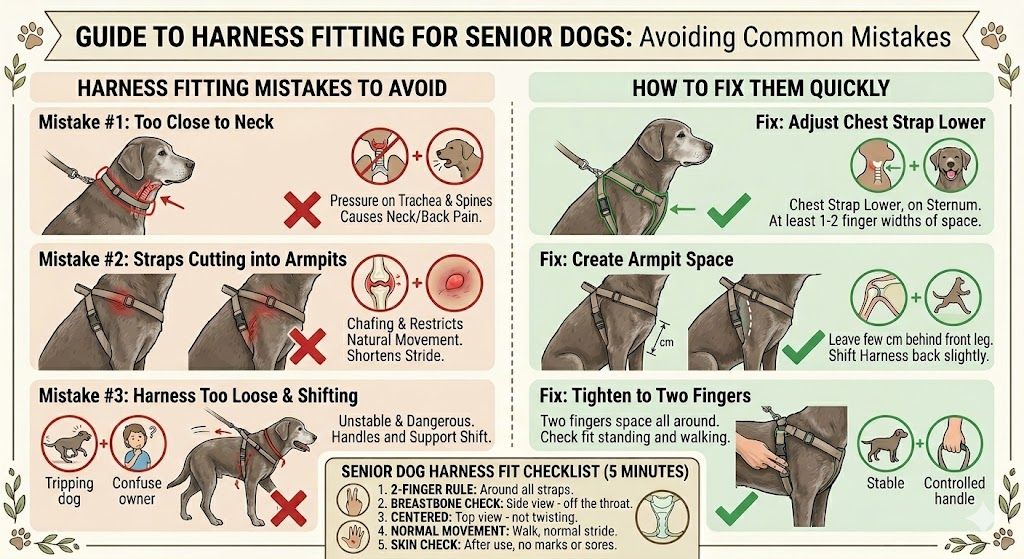
- 2 Mistake #1: Harness Sitting Too Close to the Neck
- 3 Mistake #2: Straps Cutting into the Armpits
- 4 Mistake #3: Harness Too Loose and Shifting
- 5 Mistake #4: Harness Too Tight Over Arthritic Areas
- 6 Mistake #5: Lifting from the Wrong Place or at the Wrong Angle
- 7 Mistake #6: Using an Active/Running Harness as a Support Harness
- 8 Mistake #7: Overcomplicated Designs for Stiff, Anxious Seniors
- 9 Mistake #8: Ignoring Coat Changes and Seasonal Fit
- 10 Mistake #9: Never Taking the Harness Off
- 11 Mistake #10: Using a Harness as a Substitute for Pain Management
- 12 How to Check Your Senior Dog’s Harness Fit in 5 Minutes
- 13 Frequently Asked Questions
- 14 Final Thoughts
Why Harness Fit Matters More for Senior Dogs
Senior dogs have less physical “wiggle room” for gear that isn’t quite right.
- Thinner skin and less muscle padding: Straps and buckles dig in more quickly, causing soreness or even skin damage.
- Arthritic joints: Poor strap placement can restrict shoulder or hip movement and make walking more painful.
- Neck and spine issues: A harness that pulls in the wrong direction can worsen neck or back pain.
- Decreased flexibility: Getting into and out of complex harnesses can be uncomfortable or frightening.
Mistake #1: Harness Sitting Too Close to the Neck
This is one of the most common and potentially harmful issues, especially for dogs with neck pain, tracheal sensitivity, or front‑leg arthritis.
Why It’s a Problem
- Straps that lie too close to the base of the neck can put pressure on the trachea when you assist or when the dog pulls.
- Neck‑adjacent harnesses can function too much like a collar, defeating the purpose of using a harness for safety.
How to Fix It
- Adjust the chest strap so it sits across the top of the sternum (breastbone) and not up on the throat.
- You should see at least 1–2 finger widths between the strap and the base of the neck when viewed from the side.
- If the design simply can’t sit lower without slipping off, consider a different harness shape.
Senior-Friendly Y-Front Harness
Mistake #2: Straps Cutting into the Armpits
Straps that run too close behind the front legs can cause chafing and restrict shoulder movement.
Why It’s a Problem
- Constant rubbing in the armpit area can cause hair loss, redness, or even open sores.
- Restricting the natural motion of the shoulder can shorten the stride and increase compensatory strain on the spine and hind legs.
How to Fix It
- Look for at least a few centimeters of space between the back of the front leg and the strap when your dog is standing.
- Adjust chest and girth straps to shift the harness slightly back without loosening so much that it slides around.
- If your dog has a very deep or barrel chest, consider harnesses specifically designed for that body type.
Padded Harness with Extended Chest Plate
Mistake #3: Harness Too Loose and Shifting
A loose harness may seem more comfortable, but for a senior dog it can be destabilizing and dangerous.
Why It’s a Problem
- Shifting harnesses can cause your dog to stumble when a strap suddenly tightens in a new place.
- Handles that flip from side to side make it hard for you to apply smooth, helpful support.
- Loose straps can catch on furniture or obstacles, especially in cramped spaces.
How to Fix It
- Tighten straps so you can slide two fingers comfortably between the harness and your dog’s body, but not more.
- Check fit both standing and walking. Some harnesses look fine when your dog is still but loosen with movement.
- Recheck fittings regularly; weight changes and coat changes (grooming, shedding) affect fit.
Mistake #4: Harness Too Tight Over Arthritic Areas
Overly tight harnesses can put constant pressure on arthritic joints or sensitive areas.
Why It’s a Problem
- Pressure over arthritic shoulders, hips, or spine can increase pain and make your dog dread the harness.
- Restricted chest straps may also limit breathing, especially in dogs with heart or lung disease.
How to Fix It
- Check for impressions in the fur or skin after removing the harness—deep marks suggest too much pressure.
- If your dog flinches when you touch under a strap, that area may be too snug or poorly placed.
- Consider harnesses with wider, padded straps that distribute pressure more evenly.
Mistake #5: Lifting from the Wrong Place or at the Wrong Angle
Even a perfectly fitting harness can hurt if you lift from the wrong handle or angle, especially with full‑body systems.
Why It’s a Problem
- Yanking up on the front handle alone can overload the front legs and neck.
- Lifting only the rear can create a “teeter‑totter” effect, stressing the spine.
- Rapid, jerky lifting increases pain and fear.
How to Fix It
- Use both front and rear handles together for dogs with back issues whenever possible, keeping the spine level.
- Think “assist” rather than “hoist”—you’re sharing the load, not carrying the entire dog unless truly necessary.
- Practice slow, smooth lifts from a sit to a stand before trying stairs or car entry.
Mistake #6: Using an Active/Running Harness as a Support Harness
Harnesses designed for sports or pulling are not automatically safe for lifting or weight‑bearing support.
Why It’s a Problem
- These designs may lack handle placement or padding appropriate for weight support.
- Lifting from areas not designed for load can cause strap failure or discomfort.
How to Fix It
- Reserve sports harnesses for walking or controlled exercise only.
- Use dedicated support or lift harnesses when you know you’ll need to assist with stairs, car access, or major weight‑bearing tasks.
Mistake #7: Overcomplicated Designs for Stiff, Anxious Seniors
Some harnesses offer many straps and buckles for adjustability but are overwhelming for a dog who already dislikes being handled.
Why It’s a Problem
- Repeated leg‑lifting and twisting to get into complicated harnesses can be painful for arthritic dogs.
- Complex gear can increase stress before a walk even starts, leading to more resistance and tension.
How to Fix It
- Look for step‑in or wrap‑around designs that require minimal leg lifting.
- Prioritize ease of on/off over “feature overload” when choosing for a senior dog.
- Practice putting the harness on at calm times indoors, with treats, to build positive associations.
Mistake #8: Ignoring Coat Changes and Seasonal Fit
As dogs age, their body composition and coat can change across seasons. A harness that fit last year may not fit now.
Why It’s a Problem
- Weight loss or muscle wasting can cause harnesses to become too loose and unstable.
- Thicker winter coats can compress under straps, altering pressure points.
How to Fix It
- Recheck and adjust harness fit at least every few months, and after any major grooming.
- If your dog has lost significant weight, consider downsizing or switching to a more adjustable model.
Mistake #9: Never Taking the Harness Off
Some families leave support harnesses on all day out of convenience. For many seniors, that’s not ideal.
Why It’s a Problem
- Constant contact can trap moisture and cause skin irritation or hot spots.
- Pressure on the same areas all day can become uncomfortable or painful.
How to Fix It
- Give your dog regular “naked” breaks during the day, especially for long naps and overnight.
- Check skin under straps at least weekly for redness, hair loss, or sores.
- If your dog needs near‑constant assistance, look for the softest, best‑padded options and confirm fit is perfect.
Mistake #10: Using a Harness as a Substitute for Pain Management
No harness can fully compensate for unmanaged pain. Sometimes, families reach for more gear when what their dog really needs is medical adjustment.
Why It’s a Problem
- A dog in significant pain may resist any harness, no matter how well it fits.
- Relying solely on mechanical aids can delay needed veterinary care.
How to Fix It
- If your dog becomes increasingly reluctant to move even with a good harness, talk to your veterinarian about pain control.
- Use harnesses in partnership with appropriate medications, supplements, and possibly rehab—not as a replacement.
How to Check Your Senior Dog’s Harness Fit in 5 Minutes
Here’s a quick, clinic‑style checklist you can use at home.
- With your dog standing, feel around every strap: can you fit two fingers under it comfortably, without gaps?
- Look from the side: is the front strap on the breastbone, not pressing into the throat?
- Look from above: does the harness sit centered, or does it twist to one side when your dog walks?
- Check movement: ask your dog to walk a few steps—do they move normally, or do they shorten their stride or paddle awkwardly?
- Remove the harness: check for any marks or sore spots on the skin or in the fur.
Frequently Asked Questions
Can a harness actually make my senior dog’s arthritis worse?
Yes, if it rubs on painful joints, restricts normal movement, or causes your dog to move in unnatural ways. A well‑fitted, well‑used harness should reduce strain, not add to it.
Should I get a different harness for walks vs. lifting support?
Sometimes. Light, simple harnesses are great for everyday walks, while more structured full‑body systems are better when you need to help with stairs, car access, or major weight‑bearing. Some products do both well; others do not.
My dog hates the harness now—did I ruin it?
Not at all. You may need to adjust fit, change the type, or rebuild positive associations with short, treat‑filled sessions. If pain is the issue, addressing that medically often changes their attitude dramatically.
Final Thoughts
Harnesses are powerful tools for supporting senior dogs—but they’re not “set and forget” devices. The same care you put into choosing them needs to go into fitting, adjusting, and using them thoughtfully as your dog’s body changes. When harnesses are comfortable, correctly placed, and used with a gentle, supportive touch, they can transform everyday challenges like stairs, car rides, and slippery floors into manageable tasks.
Take a few minutes this week to reassess your senior dog’s harness fit with fresh eyes. Small tweaks in strap placement, tightness, or how you lift can mean the difference between a tool that quietly helps and one that unintentionally hurts. Your dog may not be able to explain what’s wrong—but their body will show you the truth once the harness truly fits them, inside and out.