
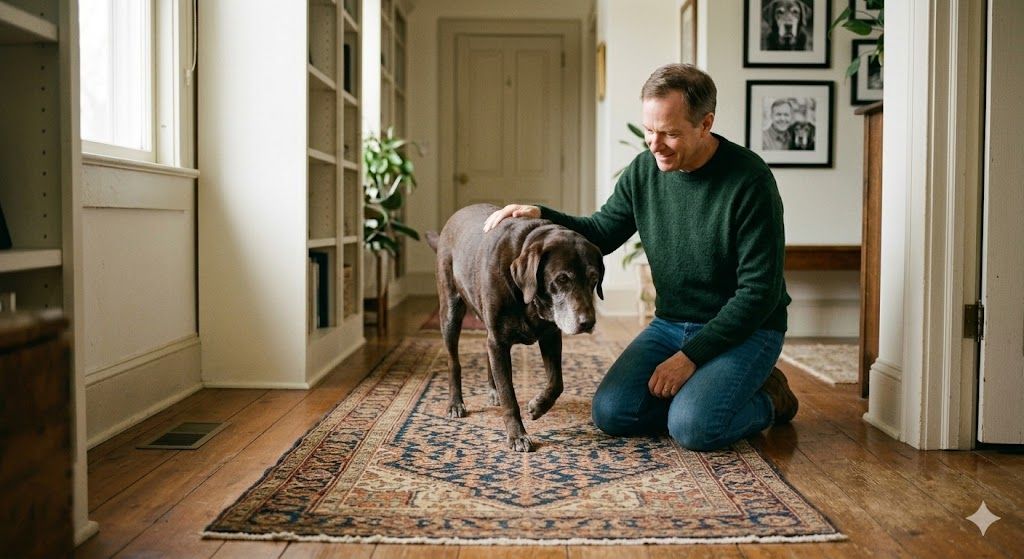
When a senior dog starts slipping on hardwood or tile, the instinct is often to buy a rug—any rug—and put it somewhere near the problem. But a rug placed in the wrong spot, or one that slides itself, can actually make things worse. Creating genuinely safe paths through your home for an arthritic or weak dog is more strategic than it looks, and the right choices here can make a meaningful difference in how confidently your dog moves every single day.
In this Guide
- 1 Think in Routes, Not Random Coverage
- 2 Runners: The Most Practical Solution for Hallways and Long Routes
- 3 What Makes a Rug or Runner Actually Non-Slip
- 4 Surface Texture: What Your Dog’s Paws Need
- 5 Covering Key Transition Zones
- 6 Rug Edges and Trip Hazards
- 7 Cleaning Without Losing Grip
- 8 Budget-Friendly Strategy for Outfitting a Whole House
- 9 When Rugs Alone Aren’t Enough
Think in Routes, Not Random Coverage
The most effective approach isn’t to cover as much floor as possible—it’s to cover the routes your dog actually uses.
- Watch your dog move through the house for one day and note the paths they take most: from their bed to the door, from the door to their water bowl, from the living room to wherever you spend most evenings.
- These “highways” are where slips happen most often, because your dog is moving with some momentum and purpose rather than standing still.
- Key transition zones also matter: the space where they rise from their bed, the patch near the back door where they plant their feet to go outside, and the area at the bottom of any ramp or stairs.
Once you’ve mapped the real routes, you can invest in the right lengths and placements rather than scattering mismatched rugs that don’t actually connect the dots.
Runners: The Most Practical Solution for Hallways and Long Routes
For main travel paths—especially hallways and the stretch from bedroom to back door—long runners are far more useful than individual rugs.
- A runner creates a continuous line of traction so your dog doesn’t have to step off one rug and navigate a gap of slippery floor before reaching the next.
- For senior dogs with rear-leg weakness, even a brief patch of slick floor mid-stride can cause a stumble that wastes energy and creates anxiety about that route.
- Choose runners that are long enough to truly span the space; a 150 cm runner in a 300 cm hallway creates two uncovered zones that undermine the purpose.
Look for runners with a low pile height (under 1 cm)—thick, plush runners can catch paws or make a dog with proprioceptive issues feel unsteady.
What Makes a Rug or Runner Actually Non-Slip
This is where most purchases go wrong. “Non-slip” on a rug label can mean almost anything—or nothing at all once the rug is on your floor.
Non-Slip Backing
- Rubber or latex backing provides the most reliable grip directly on hardwood, laminate, and tile.
- Felt backing is soft and gentle on floors but slides more easily—better suited for use with a separate non-slip pad underneath.
- Avoid rugs with thin, loosely woven backing; it wears out quickly and loses grip after a few washes.
Separate Non-Slip Rug Pads
For any rug that doesn’t have reliable integrated grip, a quality non-slip pad underneath is non-negotiable in a home with a senior dog.
- Cut the pad slightly smaller than the rug (2–3 cm on each side) so it stays hidden and doesn’t create a trip edge.
- Open-weave rubber or PVC mesh pads grip both the floor and the rug backing simultaneously—they outperform felt pads on smooth floors.
- Check the pad every few weeks; over time, dust and debris can reduce grip. A quick shake or rinse restores it.
Surface Texture: What Your Dog’s Paws Need
The top surface of the rug matters just as much as the backing. You want traction for your dog’s paws, not just a rug that stays in place.
- Low-pile woven rugs: Good paw contact, stable surface, easy to clean. Best overall choice for senior dogs.
- Berber/loop pile: Durable and provides decent grip, but loops can occasionally catch a dog’s nails—check the loop size if your dog has long or curved nails.
- High-pile or shag rugs: Generally poor choice; the uneven, soft surface can make a dog with rear-end weakness feel unstable, and paws can sink in unpredictably.
- Outdoor/sisal-style rugs: Very grippy but rough on sensitive paw pads—better near the door than in sleeping or resting areas.
Covering Key Transition Zones
Beyond hallways, certain spots in the home are disproportionately risky for senior dogs and deserve targeted coverage.
The Rise Zone
Where your dog gets up from lying down is one of the highest-risk moments of their day. The push-off from rest loads all four legs unevenly while the surface underfoot matters most.
- Place a rug or mat that extends at least 60–90 cm in every direction from the edge of their sleeping area so they land on grip, not bare floor, every time they stand.
- Low-pile rugs or interlocking foam mats with a textured top surface work well here.
The Door Threshold
Dogs rush toward doors when excited—exactly when slips happen. A doorway mat extending both inside and outside the door gives them traction for the launch and landing.
- Choose a mat that won’t curl at the edges when wet (a common problem with standard bath mats used as door mats).
- A rubber-backed outdoor-style mat inside the door and a flat anti-fatigue mat outside the door is an effective combination.
Base of Ramps and Stairs
The bottom of a ramp or the last step of an indoor staircase is where momentum meets a floor surface. Place a rug or mat here to absorb the landing and give four-paw traction the moment they step off.
Rug Edges and Trip Hazards
A rug that curls, bunches, or has a thick beveled edge can trip a dog who drags their feet—which many arthritic seniors do.
- Choose rugs with flat, thin edges rather than tapered or beveled borders that create a small “ramp” a shuffling paw can catch on.
- Use rug-edge tape or carpet tacks under any edge that tends to lift, particularly in high-traffic zones.
- Check rug edges weekly at first; foot traffic and pet movement cause edges to lift gradually before you notice them.
Cleaning Without Losing Grip
Senior dogs with incontinence, mobility issues, or outdoor mud mean rugs get dirty fast. Cleaning them wrong degrades the grip.
- Most rubber-backed rugs can be machine washed on a gentle, cool cycle; high heat melts or cracks rubber backing.
- Air dry rather than tumble dry to preserve both backing and pile integrity.
- Spot-clean daily if needed, and do a full wash when the backing feels “slippery” to your own hand—that’s your cue it has lost effective grip.
Budget-Friendly Strategy for Outfitting a Whole House
Replacing every floor surface in your home isn’t realistic for most people. A prioritized, phased approach gets you the most safety for the least cost.
- Phase 1: Cover the path from your dog’s sleeping area to the back door—this is used dozens of times a day.
- Phase 2: Add coverage in the room where your dog spends most time with the family and around their food/water station.
- Phase 3: Fill gaps between covered areas with individual mats so no stretch of bare floor exceeds about 60–90 cm.
You don’t need designer rugs or color-coordinated sets. Plain, low-pile rugs in neutral colors from a hardware or home store are often more durable and better gripping than expensive pet-specific versions.
When Rugs Alone Aren’t Enough
If your dog is still slipping on rugs, or slipping at points in the house you can’t easily rug, layering solutions works better than any single fix.
- Non-slip socks or paw wax on top of a rug path can close the remaining gaps, especially for dogs with worn paw pads or nail-length issues.
- A paw wax applied to the pads provides traction on any surface for several days and is useful for dogs who won’t tolerate socks.
- Tackle flooring, paw traction, and strength-building simultaneously—rug coverage makes their environment safer, but some muscle conditioning work helps them recover from small slips more reliably.