
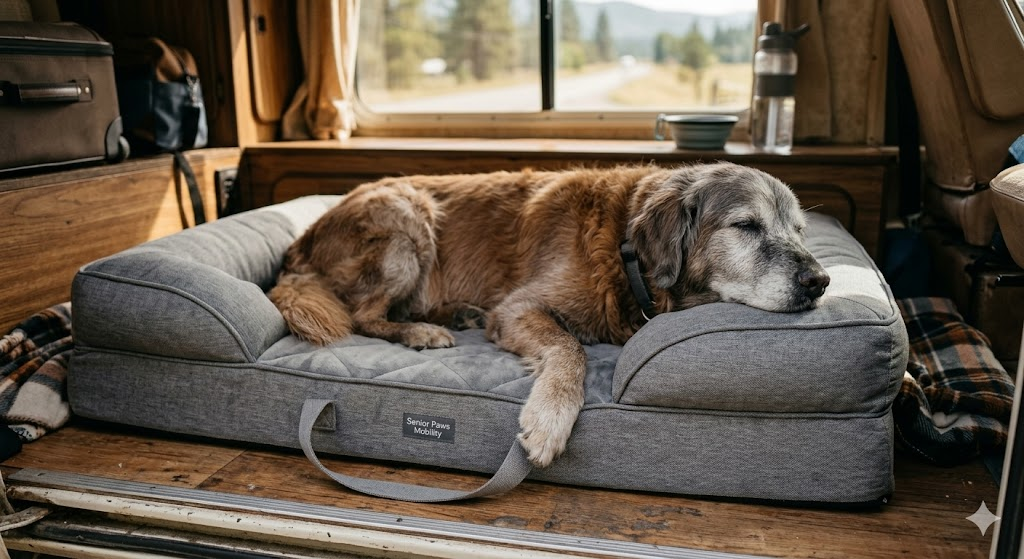
Taking your senior dog on the road, to a hotel, or for a stay at a family member’s home sounds lovely in theory—until you realize that unfamiliar hard floors, cold tile, and thin blankets on guest room carpets can undo weeks of careful joint management at home. The right travel bedding isn’t an optional comfort item; for a dog managing arthritis or rear-leg weakness, it’s what keeps the trip from leaving them worse off than before they left.
In this Guide
Why Home Beds Don’t Simply Travel With You
Your senior dog’s regular orthopedic bed was chosen for your home—it’s sized for a specific spot, probably heavy, and not designed to fold into a car trunk. Most owners end up packing a flat blanket instead and hoping for the best. That gap in support is where the problem starts.
- Older dogs spend more hours lying down. Each hour on an unsupportive surface creates pressure at elbows, hips, and shoulders that accumulates into measurable stiffness by morning.
- New environments mean cold floors, unfamiliar textures, and no traction—all of which reduce your dog’s willingness to move freely and confidently.
- Stress from travel already raises cortisol levels, which can amplify pain perception; a familiar, comfortable bed acts as a physical and emotional buffer.
A travel orthopedic bed is not a luxury add-on. It’s the difference between a trip your dog recovers from well and one that sets their mobility back.
What Makes a Bed Genuinely Travel-Worthy
Not every bed marketed as “portable” or “travel-friendly” actually offers meaningful orthopedic support. These are the specs that matter.
- Foam density and thickness: High-density foam of at least 5–8 cm for small dogs and 8–12 cm for medium to large seniors is the baseline for genuine joint protection. Anything thinner or softer will compress flat overnight.
- Packable format: Tri-fold or roll-up designs work better than rigid beds for car boots and luggage. Look for integrated carry handles or a dedicated carry bag.
- Weight: Under 3–4 kg for medium-sized options is realistic without sacrificing foam quality. Heavier beds tend to stay home.
- Waterproof inner liner: Accidents happen more often in unfamiliar environments. A waterproof liner protects the foam core and extends the bed’s usable life.
- Washable, removable cover: You need to be able to clean it without a laundromat. Machine-washable covers with durable zippers are non-negotiable.
- Non-slip base: Hotel tile and hardwood at family homes are often the slickest surfaces your dog will encounter. A rubberized or textured base keeps the bed anchored when they push off to stand.
Matching Bed Type to Trip Type
One format doesn’t suit every trip. Knowing what you’re facing helps you pack the right setup.
Car Trips and Road Travel
- Use a crate-pad-style orthopedic mat in the cargo area or backseat rather than a loose blanket. Foam absorbs road vibration and prevents pressure buildup during long stretches of lying down.
- Secure the bed with a non-slip mat underneath or anchor it against the seat base so it doesn’t slide during braking.
- For very long drives, bring a small secondary mat for rest stops—letting your dog lie on cold, wet pavement while they stretch defeats the purpose of the main bed in the car.
Hotels and Vacation Rentals
- Expect polished concrete, laminate, or thin hotel carpet. Set up the travel bed immediately upon arrival so your dog has a known safe spot before they start exploring.
- Layer a non-slip yoga mat or rubber mat underneath the travel bed if the floor is especially smooth.
- Position the bed away from the door, air conditioning vents, and high-traffic areas. Drafts and cold airflow worsen joint stiffness overnight.
Staying with Family or Friends
- Ask in advance about floor types and available space so you can confirm your chosen bed fits the room layout.
- Bring the bed’s usual cover from home, or at least a pillowcase from your dog’s regular bed. Familiar scent reduces anxiety and helps them settle faster in a strange space.
- Set up the bed before your dog explores the house so they discover it early and associate it with rest from the start of the visit.
Using Familiar Scent as a Mobility Tool
This is one of the most overlooked elements of travel bedding for senior dogs. A dog that feels secure settles more quickly, rests more deeply, and wakes up less stiff.
- Sleep a worn t-shirt or a cloth from your home bed on the travel bed for a few nights before the trip so it carries familiar scent.
- If your dog uses a specific blanket at home, bring it to layer over or alongside the travel bed—the orthopedic foam handles joint support while the familiar blanket handles psychological ease.
- Avoid laundering the travel bed cover immediately before a trip. A slightly used cover smells like home; a freshly washed one smells like detergent in an already-strange place.
Managing Incontinence Away from Home
Older dogs leak more frequently when they’re anxious, sleeping more deeply than usual on a proper bed, or simply in an environment where they didn’t learn the house signals.
- Pack at least two spare covers so you can swap mid-trip without leaving your dog on bare floor.
- Bring a small bottle of enzyme cleaner and two absorbent microfiber towels—these handle accidents without leaving odors that cause your dog to repeat the spot.
- Consider a waterproof, washable belly band or dog diaper for overnight use in settings where an accident would be especially problematic.
Waterproofing your foam core is the single decision that determines whether a travel bed lasts one trip or two years. Wet foam compresses unevenly and develops odors that no washing eliminates.
Building a Repeatable Packing System
The best travel bed is the one that actually gets packed. Friction in the packing process is what causes owners to leave it at home.
- Store the travel bed folded and strapped in its carry bag on a shelf near your other dog travel items, not buried in a closet.
- Keep a small dedicated tote containing: spare bed cover, dog wipes, enzyme cleaner, and one familiar blanket. Grab it whole rather than assembling pieces each trip.
- After each trip, inspect the foam for compression, the cover for damage, and the liner for any seal failure. A five-minute post-trip check extends the bed’s life significantly.
When a Travel Bed Isn’t Enough Alone
For dogs with more advanced mobility challenges, the bed is part of a broader travel setup rather than the complete solution.
- Bring a lightweight portable ramp if your dog normally uses one to access beds or car seats at home—don’t assume they’ll manage a jump they can’t do at home.
- Pack your dog’s regular non-slip socks or booties for unfamiliar slippery floors that the bed’s non-slip base can’t address.
- If your dog uses a support harness at home for help getting up, it’s likely more necessary on a trip than at home, where floors, layout, and distances are all unknown.
Travel with a senior dog requires more preparation, but none of it is complicated once you have the right kit assembled. A dependable orthopedic bed that actually comes with you means your dog doesn’t have to “pay” for the trip with extra stiffness and a slower recovery afterward.