
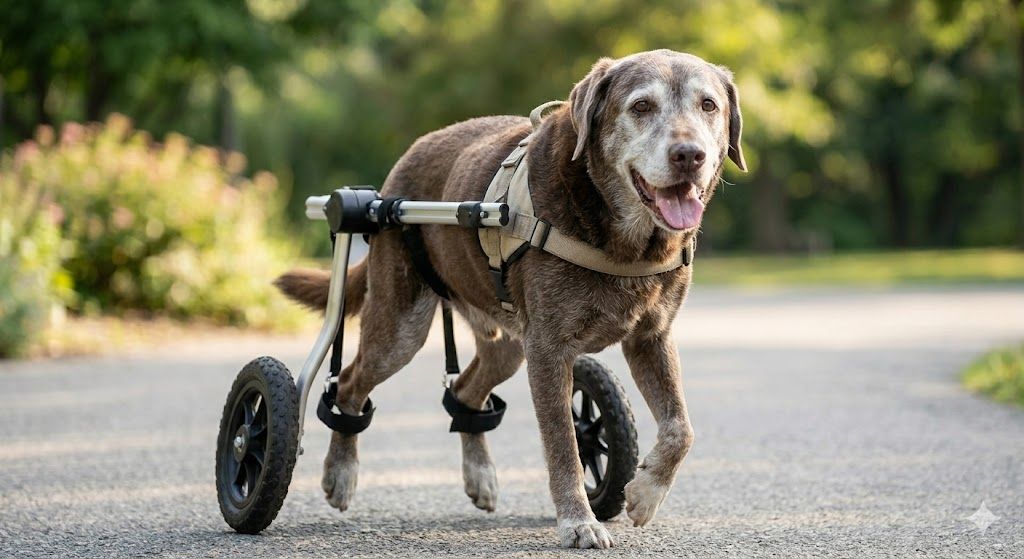
There’s a particular kind of love that grows between a person and their aging dog — deeper, quieter, and more tender than anything you imagined on the day you brought them home. You’ve watched them slow down. You’ve noticed the mornings getting harder, the stairs becoming a hesitation instead of a habit. And now you’re here, researching wheelchairs, wondering if this is the right call, and perhaps feeling a little heartbroken about it.
Let that feeling be proof of how much you love them. Then let this guide help you turn that love into action. A dog wheelchair is not a symbol of giving up — it’s the opposite. It’s you saying: you still have life to live, and I’m going to help you live it. Dogs don’t mourn their limitations the way we do. They want to move, to sniff, to feel the grass under their paws, to be near you. A wheelchair gives them that back.
In this Guide
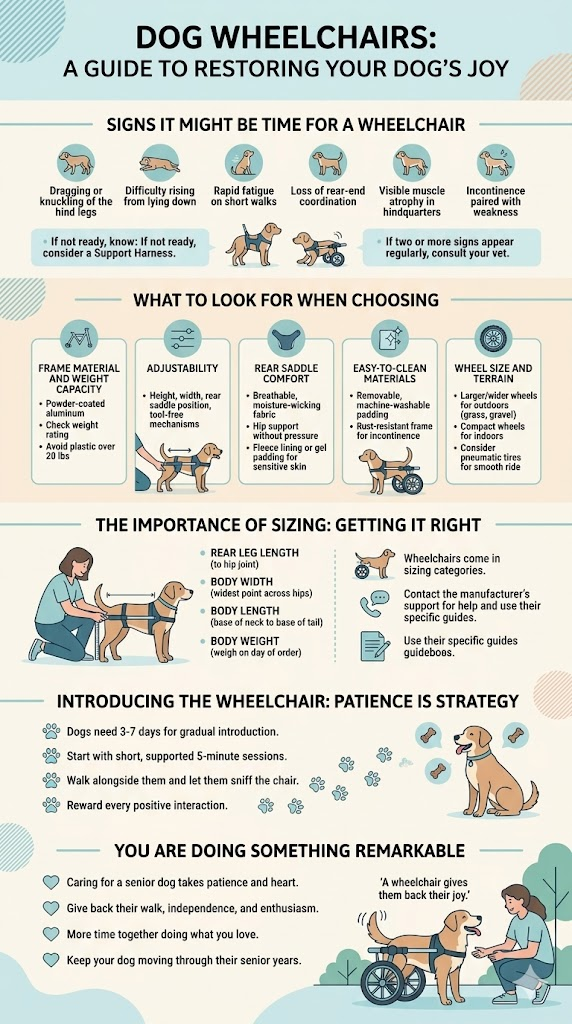
Signs It Might Be Time for a Wheelchair
Every dog’s journey is different, but certain physical signs consistently indicate that a mobility aid could transform your dog’s daily life. Watch for these:
- Dragging or knuckling of the hind legs — when the back paws scrape the ground instead of lifting properly during movement
- Difficulty rising from a lying position — struggling, needing multiple attempts, or requiring your help to stand
- Rapid fatigue on short walks — stopping frequently, sitting down mid-walk, or refusing to continue after just a few minutes
- Loss of rear-end coordination — stumbling, swaying, or crossing the hind legs while walking
- Visible muscle atrophy in the hindquarters — noticeable thinning of hind leg muscles from prolonged disuse
- Incontinence paired with weakness — spinal conditions often affect both mobility and bladder control simultaneously
If your dog isn’t ready for a full wheelchair, a support harness can offer the extra lift they need to get up stairs or into the car comfortably.
If two or more of these signs appear regularly, speak with your vet about whether a wheelchair is appropriate. Many dogs who seem too compromised for mobility aids thrive remarkably once they’re supported upright and free to move again. The body responds to movement — even assisted movement rebuilds confidence, stimulates circulation, and slows further muscle loss.
Wheelchair for Medium Dogs
What to Look for When Choosing a Dog Wheelchair
The difference between a wheelchair your dog accepts and one they refuse often comes down to fit, comfort, and build quality. Here’s what actually matters:
Frame Material and Weight Capacity
Choose a frame rated well above your dog’s current weight. A frame operating near its maximum capacity flexes and shifts underfoot, which unsettles dogs quickly and discourages use. Powder-coated aluminum offers the best combination of structural strength and light weight — your dog shouldn’t be working harder just to push the chair itself. Avoid plastic-framed options for any dog over 20 pounds; they flex too much under dynamic load.
Adjustability
Your dog’s body will change over time. Muscle atrophy, weight fluctuation, and postural shifts are all common in senior dogs with mobility conditions. A wheelchair with adjustable height, width, and rear saddle positioning lets you fine-tune the fit as their needs evolve. Prioritize tool-free adjustment mechanisms — you’ll be tweaking the setup more often than you expect, especially in the first few weeks of introduction.
Rear Saddle Comfort
The rear saddle — the padded cradle that supports your dog’s hindquarters — is where comfort is won or lost. Look for breathable, moisture-wicking fabric rather than dense closed-cell foam, which traps heat and causes skin irritation during longer sessions. The saddle should support the hips evenly without pressing on the spine or abdomen. If your dog has skin sensitivities or existing pressure sores, look for saddles with fleece lining or gel padding inserts.
Easy-to-Clean Materials
Senior dogs with mobility challenges frequently experience some degree of incontinence. This is not something to work around — it’s something to plan for. Choose a wheelchair with removable, machine-washable padding and a rust-resistant frame that tolerates regular rinsing. A chair that’s difficult to clean will become unhygienic quickly, creating skin and odor issues that make the whole experience miserable for your dog.
Wheel Size and Terrain
Larger, wider wheels handle outdoor terrain — grass, gravel, sidewalk cracks — far better than narrow inline wheels. If your dog will primarily use the chair indoors on smooth floors, compact wheels are fine. If outdoor walks are the goal (and they should be — that sensory experience is enormously valuable for senior dogs), choose a model with at least 8-inch rear wheels and consider pneumatic tires for the smoothest ride.
The Importance of Sizing: Getting It Right Before You Buy
This is the step most owners rush — and the one that matters most. Dog wheelchairs typically come in three main size categories: Small, Medium, and Large, each designed around a specific range of body measurements and weight. A wheelchair that’s even slightly too wide, too narrow, or incorrectly positioned at the rear will cause pressure points, postural imbalance, and frustration that can make your dog refuse the device entirely.
Before purchasing, take the following measurements with your dog in a natural standing position — ideally with someone gently steadying them:
- Rear leg length — from the floor to the top of the hip joint
- Body width at the widest point — typically across the hips
- Body length — from the base of the neck to the base of the tail
- Body weight — weigh them on the day you order, not from a months-old vet record
Every manufacturer provides its own sizing chart and measurement guide — follow it exactly, even if it means your dog falls between two sizes. When in doubt, contact the manufacturer’s support team directly. Most are genuinely helpful and will guide you to the correct size based on your specific measurements. A 10-minute call can save weeks of returns and a frustrated dog.
For small dogs under roughly 25 pounds, explore our recommended small-size wheelchair options For medium dogs between 25 and 55 pounds, these mid-size models offer excellent adjustability . For large breeds over 55 pounds, heavy-duty construction and wide-base stability are non-negotiable .Wheelchair for Big Dogs.
Introducing the Wheelchair: Patience Is the Strategy
Don’t expect your dog to take off confidently on day one — and don’t be discouraged if they don’t. Most dogs need three to seven days of gradual introduction before they move freely in a wheelchair. Start with short, supported sessions of five minutes while you walk alongside them. Let them sniff the chair before each use. Reward every positive interaction generously. Within a week, the majority of dogs shift from hesitation to enthusiasm — especially once they realize the chair means outside and movement and you.
You Are Doing Something Remarkable
Caring for a senior dog with mobility challenges takes patience, research, financial commitment, and an enormous amount of heart. The fact that you’re reading this, measuring your dog, comparing options, and thinking carefully about their comfort means you are already giving them something most dogs never get — a person who refuses to let them fade quietly into the background.
A wheelchair won’t turn back time. But it will give your dog back their walk, their independence, their tail-wagging enthusiasm for a morning in the yard. It will give you more time together doing the things you both love. And in the world of senior dog care, that is everything.
You’ve got this. And so do they.