

When you’re trying to help a senior dog with arthritis sleep more comfortably, the question of raised versus flat beds comes up quickly—and the answer is less obvious than it seems. Both styles have genuine benefits, and both have real drawbacks for aging bodies. The right answer depends not on which type is “better” in general, but on your specific dog’s joint issues, mobility level, and how they like to sleep.
In this Guide
- 1 What Raised (Elevated) Beds Actually Do
- 2 Where Raised Beds Fall Short for Arthritic Dogs
- 3 What Flat Orthopedic Beds Offer
- 4 Where Flat Beds Fall Short
- 5 The “Best of Both” Option: Raised Orthopedic Beds
- 6 Matching Bed Type to Specific Arthritis Patterns
- 7 Practical Considerations Beyond the Bed Type
- 8 Testing the Bed Before Committing
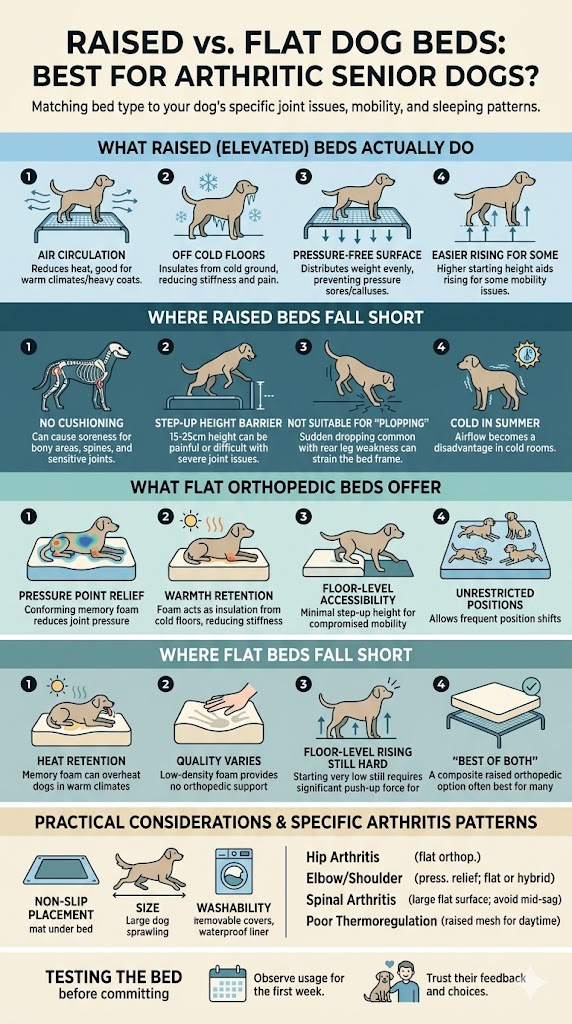
What Raised (Elevated) Beds Actually Do
Raised or elevated beds suspend your dog on a taut fabric or mesh surface, keeping them off the floor entirely. This design has specific benefits that make it genuinely useful in some situations.
- Air circulation: Air flows under and around the dog, reducing body heat buildup—valuable for heavy-coated breeds or dogs in warm climates whose inflammation is worsened by heat.
- Off cold floors: Elevation keeps the dog away from cold ground, which can stiffen muscles and increase joint pain, particularly in winter months.
- Pressure-free surface: A well-tensioned elevated bed distributes weight across the whole surface without a single pressure point—important for dogs prone to pressure sores or calluses.
- Easier rising for some dogs: Because the surface is at a higher starting height, dogs who struggle to rise from floor level may find it slightly easier to get their legs under them.
[Insert Amazon Affiliate Link Here]
Where Raised Beds Fall Short for Arthritic Dogs
Despite those advantages, raised beds are not universally better for senior dogs—and for some, they’re actively the wrong choice.
- No cushioning: Elevated beds typically provide no foam or padding. A dog with pressure-sensitive hip bones, elbows, or a bony spine may develop soreness on a taut surface despite the distribution advantage.
- Step-up height is a barrier: Most elevated beds sit 15–25 cm off the ground. For a dog with severe hip dysplasia or hind-leg weakness, stepping up onto the platform and lowering themselves down can be painful or unstable.
- Not suitable for dogs who “plop”: Dogs who drop suddenly rather than lowering themselves gently—which is common with weak rear legs—can strain the bed frame and potentially injure themselves on the edges.
- Cold in summer, not warm enough in winter: The airflow advantage becomes a disadvantage in cold rooms or during winter when you actually want the bed to retain some warmth.
What Flat Orthopedic Beds Offer
Flat beds, when built correctly, are the most widely recommended option for arthritic senior dogs—and for good reason.
- Pressure point relief through foam: A quality memory foam or layered foam bed conforms to the dog’s body, reducing concentration of pressure at hips, shoulders, and elbows—the exact sites that suffer most in arthritis.
- Warmth retention: Foam insulates from cold floors, reducing joint stiffness during sleep.
- Floor-level accessibility: A flat bed at floor level requires no step-up, meaning even severely compromised dogs can lower themselves down and rise without additional vertical challenge.
- Positions without restriction: Arthritic dogs often shift positions frequently during sleep to relieve discomfort. A flat, wide surface lets them move freely without risking rolling off an edge or hitting a frame.
[Insert Amazon Affiliate Link Here]
Where Flat Beds Fall Short
Flat beds have their own limitations, and being honest about them helps you choose or combine options wisely.
- Heat retention: Memory foam retains heat—in summer or in warm rooms, a large dog on a memory foam bed can become uncomfortably warm, especially breeds with dense coats.
- Quality varies enormously: A low-density flat bed that compresses to nothing under a heavy dog offers none of the benefits and can feel worse than a hard floor for a large breed.
- Floor-level rising can still be hard: Some dogs with very severe hip weakness find that starting from floor height is a disadvantage, because they need their rear legs far under them before they can push up.
The “Best of Both” Option: Raised Orthopedic Beds
A growing category of beds combines a raised frame with an orthopedic foam or cushioned sleeping surface. For many arthritic seniors, this is the most effective single solution.
- The frame elevates the surface above cold floors and aids air circulation.
- The foam pad on top provides the pressure relief and warmth retention that a bare elevated bed can’t.
- Step-up height is typically 10–15 cm, which is manageable for most dogs who aren’t in severe rear-end decline.
Look for versions where the foam insert is removable for washing, and where the frame is sturdy enough not to flex noticeably under your dog’s weight. [Insert Amazon Affiliate Link Here]
Matching Bed Type to Specific Arthritis Patterns
Different joint conditions favor different bed characteristics. Think about where your dog’s arthritis is most severe when deciding.
Hip Arthritis or Hip Dysplasia
- Flat orthopedic beds tend to win here: floor-level access avoids the step-up that loads painful hips.
- Choose a wide, flat bed with no raised edges to step over, and place it with a non-slip mat around it. [Insert Amazon Affiliate Link Here]
Elbow or Shoulder Arthritis
- Pressure relief is the priority; elevated bare beds won’t help if elbow bones are digging into a taut surface.
- A flat orthopedic foam bed or a raised bed with a thick foam insert is better than a bare elevated option.
Spinal Arthritis or Disc Issues
- These dogs often need to sleep fully extended rather than curled, so a large, flat surface wins for space.
- Avoid beds that sag in the middle, as spinal support during sleep is important.
Dogs with Poor Thermoregulation
- If your dog overheats easily, a raised bed with a breathable mesh or fabric surface is a better daytime nap option.
- Keep a flat orthopedic option for nighttime when temperatures drop and insulation matters more.
Practical Considerations Beyond the Bed Type
A few factors apply regardless of which style you choose.
- Non-slip placement: Both flat and raised beds should sit on non-slip surfaces. A bed that slides when your dog steps on it creates exactly the instability you’re trying to remove. [Insert Amazon Affiliate Link Here]
- Size: Bigger is better for arthritic dogs who shift positions. When in doubt, size up—a dog who can sprawl fully extended on their bed sleeps more restfully than one who has to compromise their position to fit.
- Washability: Senior dogs are more likely to have bladder leaks, drool, or shed heavily. Any bed you choose needs a removable, machine-washable cover and ideally a waterproof inner liner.
Testing the Bed Before Committing
Your dog’s response in the first week tells you more than any review.
- Watch whether they choose the new bed over alternatives (floor, old bed, sofa) once the novelty has worn off—usually after day three or four.
- Observe their rising pattern: fewer attempts to get up, less wobbling on exit, and less stiffness in the first few minutes after sleeping are positive signs.
- If they actively avoid the new bed or seem restless on it, trust that feedback. A different foam density, entry style, or height may be the answer.
The bed your arthritic senior actually uses consistently is the right one—and for most large dogs with joint pain, that bed will have real foam under them, a surface at a height their joints can manage, and enough room to sleep in whatever position their body finds most comfortable that night.