
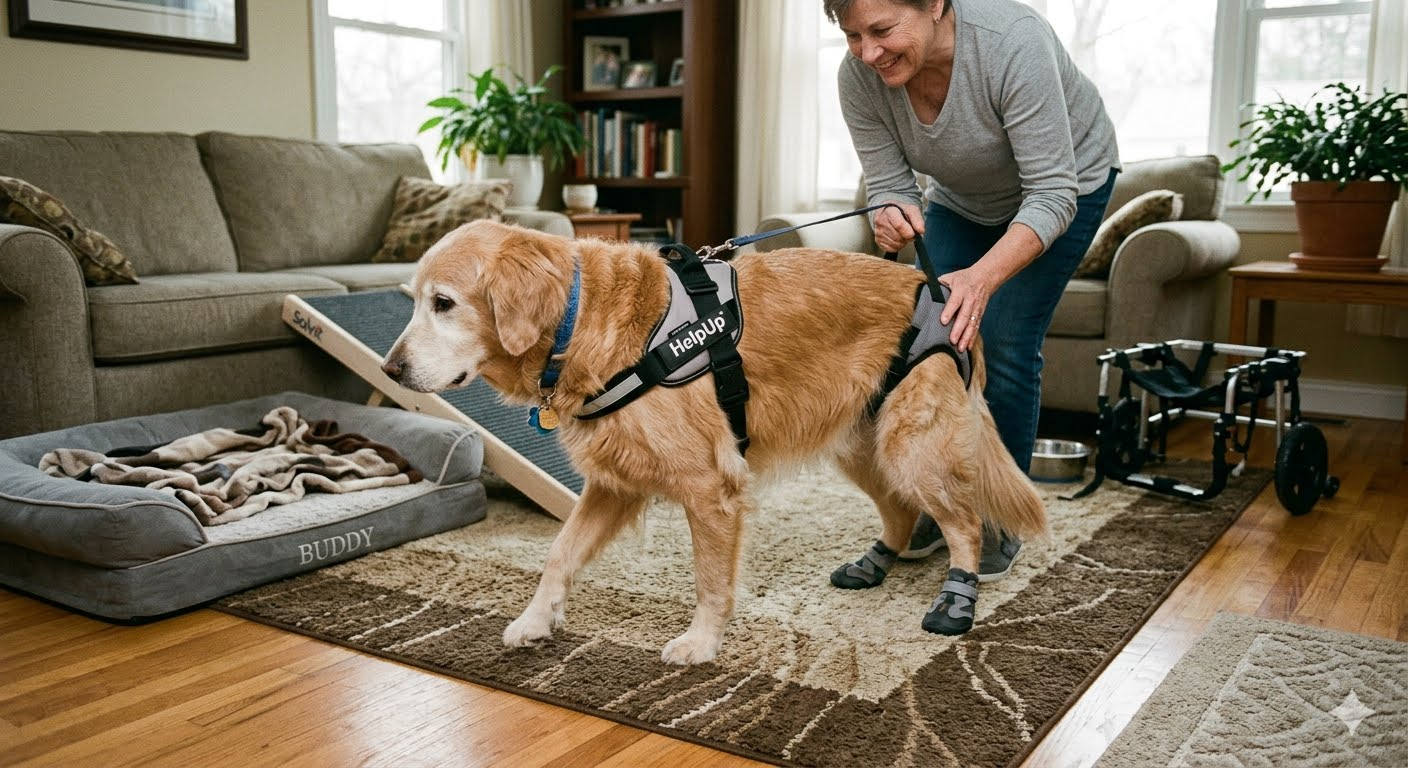
When a dog has both arthritis and rear leg weakness, daily movement can feel like a double-edged sword—you know they need to stay active to preserve what strength they have, but you can also see that overdoing it leaves them worse off the next day. Getting the balance right isn’t about finding one perfect exercise; it’s about building a daily structure with the right type of movement at the right times, followed by genuine recovery.
In this Guide
- 1 Why Consistency Matters More Than Intensity
- 2 The Morning Routine: Warming Up a Stiff Body
- 3 Midday: The Main Activity Window
- 4 Afternoon: Rest and Recovery
- 5 Evening: Short Wind-Down Activity
- 6 Managing “Bad Days” Without Abandoning the Routine
- 7 Using Assistive Equipment as Part of the Daily Routine
- 8 Tracking the Routine Without Overcomplicating It
Why Consistency Matters More Than Intensity
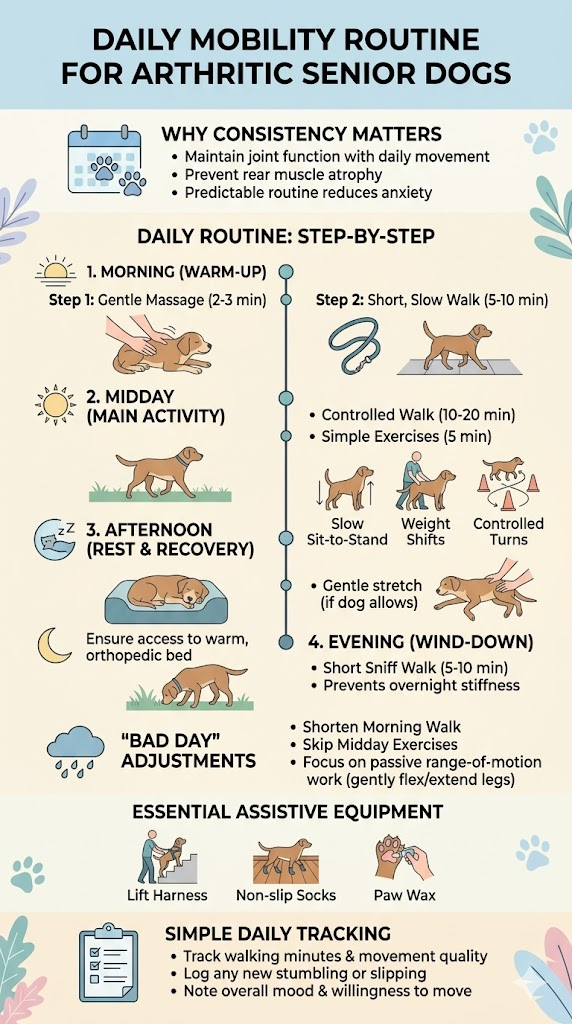
This is the most important principle for managing mobility in senior dogs with arthritis and weakness: a small amount of movement every day maintains more function than occasional longer sessions with rest days in between.
- Arthritic joints stiffen faster when they’re not moved regularly; long rest periods make the next movement more painful, not less.
- Weak rear muscles atrophy quickly without use; even short, targeted activity signals muscles to maintain their mass and strength.
- A predictable daily routine reduces anxiety—dogs with chronic pain often show less distress when their days have consistent, manageable patterns.
Think of the daily routine as maintenance, not therapy. The goal is to prevent further decline, not to fix everything at once.
The Morning Routine: Warming Up a Stiff Body
Morning is when arthritis is most noticeable. Joints that haven’t moved for hours are at their stiffest, and rear leg weakness is most apparent before muscles warm up. Never start with demanding activity right after rising.
Step 1: Gentle Massage Before Movement (2–3 minutes)
- Before your dog even fully stands, gently massage the major muscle groups around the hips, thighs, and lower back using slow, circular strokes.
- Warmth and gentle pressure increase blood flow to stiff muscles and signal the nervous system to prepare for movement.
- You’re not doing deep tissue work—light, steady contact is enough. Watch your dog’s face: relaxed jaw and eyes mean you’re in the right zone; tension or pulling away means back off.
Step 2: Short, Slow Walk (5–10 minutes)
- A short leash walk at your dog’s natural pace—not yours—is the best warm-up for arthritic joints. The motion lubricates joint surfaces with synovial fluid, which reduces friction and pain.
- Use a harness with a handle so you can provide light support if they stumble or their rear end wavers.
- Flat, even surfaces are best in the morning; save any inclines for later in the day when muscles are warmer.
- Don’t push for distance. A 5-minute shuffle around the block is worth more than a 20-minute struggle.
Midday: The Main Activity Window
Midday, when joints have had time to warm up from the morning walk, is typically when senior dogs with arthritis move best and tolerate the most activity. This is the time to fit in any structured strengthening work.
Controlled Walking
- A 10–20 minute leash walk at a steady, controlled pace—long enough to maintain cardiovascular fitness and muscle use without tiring the rear end to the point of stumbling.
- Choose varied but manageable terrain: some grass, some flat path. Varied surfaces encourage more proprioceptive engagement than continuous pavement.
- Watch for early fatigue signals: dragging the back toes, shortened stride, heavy panting, or leaning into the leash. Any of these means it’s time to turn back regardless of how far you’ve gone.
Simple Strength Exercises (5 minutes)
These don’t require equipment and can be done in your living room or yard.
- Slow sit-to-stand: On a non-slip surface, cue your dog to sit, then stand, 3–5 repetitions. The slow stand from sit activates the same muscles needed to rise from rest. Stop if they can’t fully extend the rear legs in the standing position.
- Weight shifts: With your dog standing, place a hand on each side of the hips and gently shift weight side to side 5–8 times, letting them correct their balance each time.
- Controlled turns: Walk slowly in figure-8 patterns around two fixed objects to engage different muscle groups and encourage balanced weight-bearing through turns.
These three exercises take under five minutes combined and, done daily, maintain hip and core muscle engagement that directly supports rear leg function.
Afternoon: Rest and Recovery
After midday activity, your dog needs genuine rest—not just a nap on the floor while you’re busy.
- Ensure their orthopedic bed or rest mat is accessible and in a warm, quiet spot.
- Resist the temptation to do “just one more short walk” in the afternoon if your dog is resting well; rest is when muscles repair and inflammation reduces.
- A brief gentle stretch if your dog is willing—gently extending one rear leg at a time while they lie on their side, holding for 5 seconds—can help reduce afternoon stiffness. Only do this if your dog is relaxed and doesn’t resist the movement.
Evening: Short Wind-Down Activity
A brief evening activity serves two purposes: it prevents the long overnight immobility from starting too early, and it gives your dog a chance to toilet after a long afternoon rest.
- A 5–10 minute slow sniff walk—allowing your dog to set pace completely and stop to investigate smells—is ideal. Sniffing is mentally tiring in a good way and keeps the dog relaxed for sleep.
- Avoid anything vigorous in the hour before bed; elevated heart rate and muscle activation too close to sleep can increase nighttime restlessness in pain-sensitive dogs.
- Check your dog’s rear end comfort after the walk: look for any new dragging of toes or weakness compared to this morning. These are your reference points for tomorrow’s routine.
Managing “Bad Days” Without Abandoning the Routine
Arthritis pain fluctuates with weather, activity levels, and for reasons that aren’t always obvious. Having a “bad day version” of the routine keeps some consistency without overloading a dog who needs more rest.
- On bad days, shorten the morning walk to 3–5 minutes and skip the midday exercises entirely.
- Replace active exercise with passive range-of-motion work: gently flex and extend each leg while your dog lies on a comfortable surface, 5 repetitions each leg.
- Extra warmth helps on bad days—a heated pad under their bed cover or a soft coat for outdoor trips.
- If bad days are occurring more than 2–3 times per week, talk to your vet about whether pain management needs adjustment before continuing the routine.
Using Assistive Equipment as Part of the Daily Routine
Good equipment doesn’t replace routine—it makes the routine safer and more sustainable.
- A rear support sling or lift harness used consistently on stairs and uneven ground protects joints during the moments in the routine where fall risk is highest.
- Non-slip socks worn during indoor exercise sessions prevent paw sliding on strength exercises and weight shifts.
- Paw wax applied before outdoor walks in cold or wet conditions improves grip on wet pavement and reduces the compensatory tension your dog creates when they feel insecure underfoot.
Tracking the Routine Without Overcomplicating It
You don’t need an app or a spreadsheet. A simple daily log of three things is enough.
- How many minutes of walking today, and how did they move at the end compared to the start?
- Any slipping, stumbling, or toe-dragging that was new or worse than yesterday?
- Overall mood and willingness to engage—a dog who greets the leash with interest is telling you something different from one who has to be encouraged away from their bed.
After two to three weeks, patterns emerge that help you and your vet fine-tune the balance between rest and activity. That data is also valuable at vet appointments—a written observation record is far more useful than “I think he’s about the same.”