
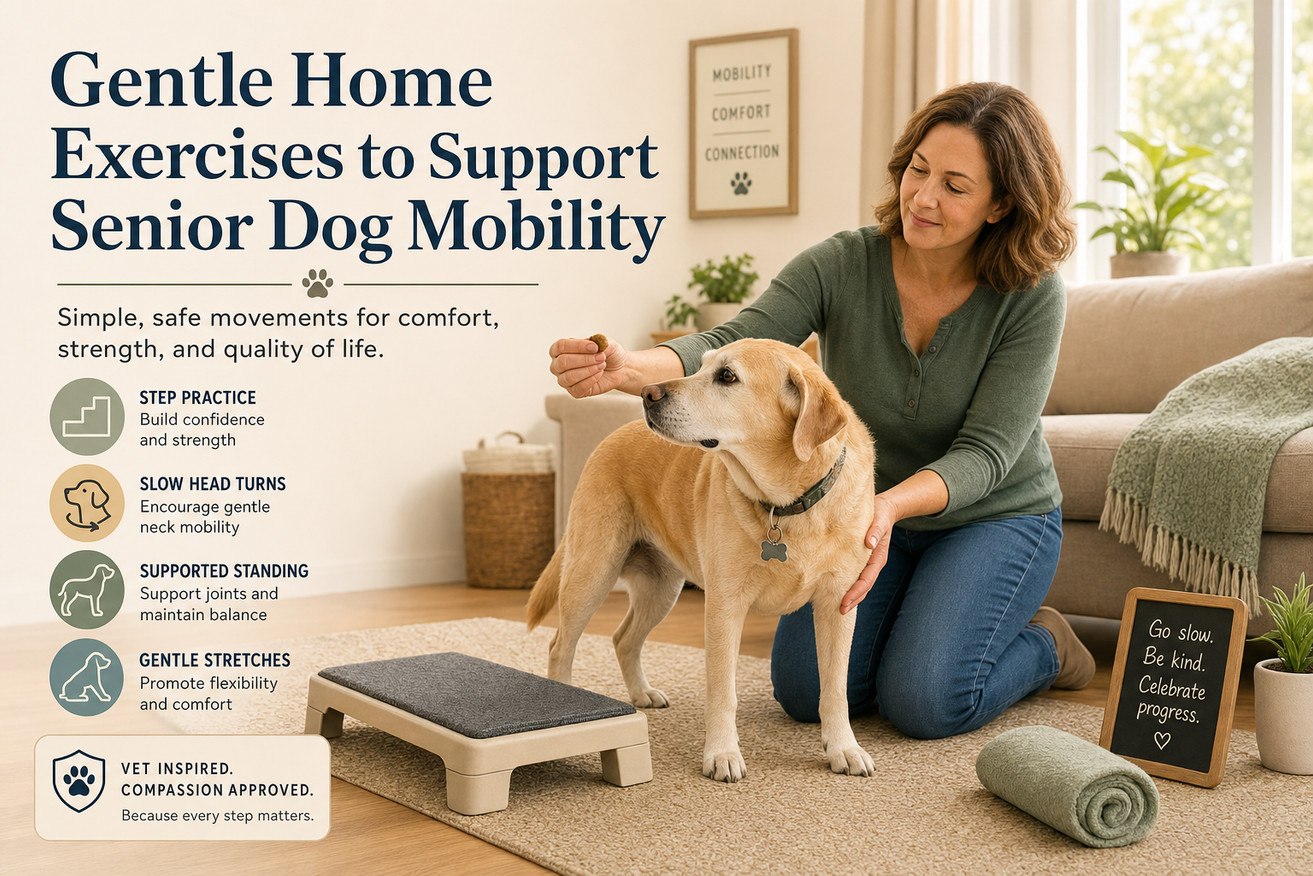
Families often tell me, “I know my senior dog needs to keep moving, but I’m afraid of hurting them.” That concern is valid and kind. The goal with home exercises for older dogs is not to turn them into athletes—it’s to maintain the strength, flexibility, and balance they need for everyday life: getting up, walking to the door, climbing a couple of steps, and settling down comfortably again.
In this guide, I’ll share gentle, vet‑friendly exercises I routinely teach to clients, plus practical tips to keep them safe. You don’t need special equipment or a huge amount of time—just a non‑slip surface, a few minutes a day, and willingness to watch your dog closely and adjust based on how they feel.
In this Guide
- 1 Before You Begin: Safety and Setup
- 2 Category 1: Strengthening Exercises for Everyday Movements
- 3 Category 2: Balance and Body Awareness (“Proprioception”)
- 4 Category 3: Flexibility and Comfort
- 5 Category 4: Core Stability and Posture
- 6 How Often Should You Do These Exercises?
- 7 Reading Your Dog’s Feedback
- 8 Helpful Tools (Optional, Not Mandatory)
- 9 When You Should Seek Professional Help
- 10 Sample Gentle Exercise Session (7–10 Minutes)
- 11 Frequently Asked Questions
- 12 Final Thoughts
Before You Begin: Safety and Setup
Think of these as your “warm‑up rules” for every home exercise plan.
- Get medical clearance: Ask your veterinarian what’s safe given your dog’s specific diagnosis (arthritis, hip dysplasia, spinal issues, heart disease, etc.).
- Work on non‑slip surfaces: Use rugs, yoga mats, or carpet; avoid bare hardwood or tile.
- Keep sessions short: 5–10 minutes is usually plenty, especially at first.
- Stop if you see pain: Limping, flinching, vocalizing, or increased stiffness afterwards means an exercise needs modification or removal.
Category 1: Strengthening Exercises for Everyday Movements
These target the muscles your senior dog uses most for standing, walking, and changing positions.
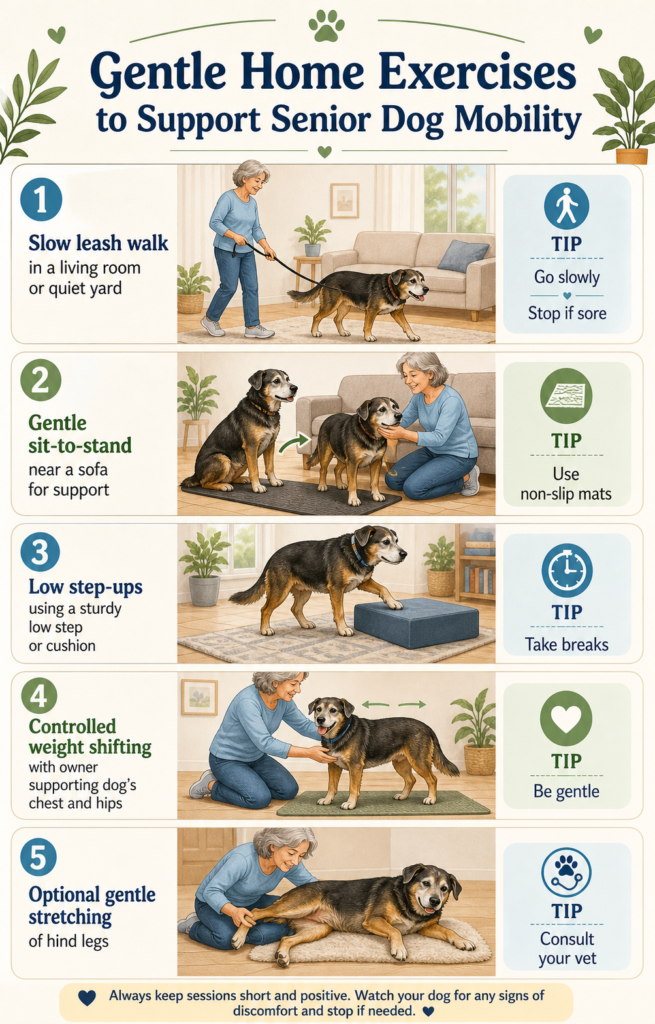
1. Controlled Sit‑to‑Stand
This is the dog equivalent of a “chair squat” and can be powerful when done thoughtfully.
- Have your dog on a non‑slip surface.
- Ask for a sit, then gently encourage them to stand using a treat held just above nose level.
- Support lightly with a harness if they struggle to get up.
- Start with 2–3 repetitions, once or twice a day, and slowly build to 5–8 if well tolerated.
Skip or modify if full sits are very painful; you can instead reward small bends and returns to standing.
2. Slow, Short Leash Walks on Flat Ground
Walking is still one of the best whole‑body exercises when scaled correctly.
- Use a harness to reduce neck strain and give you more control.
- Keep the pace steady and unhurried; avoid sudden running or jerking.
- Begin with 5–10 minutes and adjust based on how your dog handles the rest of the day.
Multiple short walks are often better than one long one for seniors.
3. Step‑Ups on a Low, Stable Surface
This can gently strengthen the hind end when done on a very small step.
- Choose a low, non‑slip step or platform (10–15 cm for small/medium dogs, slightly higher for large if comfortable).
- Use a treat to lure your dog to step up with front feet, then step down.
- If safe, progress to placing all four paws briefly on the step, then stepping back down.
- Do 3–5 repetitions on each side (leading with left, then right), a few times per week.
Avoid this if your dog has significant knee problems or struggles with even one step in daily life.
Category 2: Balance and Body Awareness (“Proprioception”)
Seniors often lose some ability to know where their feet are, which increases tripping and slipping. These exercises help gently “remind” the nervous system.
4. Weight Shifting in Stand
- Have your dog stand squarely on a non‑slip surface.
- Place your hands lightly on either side of the hips or shoulders.
- Gently rock their weight a tiny amount side‑to‑side so they have to adjust but not step.
- Do 5–10 shifts, then rest; 1–2 sets per day is usually enough.
5. “Figure‑8” Walking Around Small Objects
- Set up two objects (cones, small stools, or even boxes) a few feet apart.
- Walk your dog slowly in a figure‑8 pattern around them, encouraging smooth curves, not sharp turns.
- Do 3–5 figure‑8s, watching for signs of fatigue.
This encourages controlled turning and weight shifting in a safe, structured way.
6. Cavaletti‑Style Slow Stepping (Very Low Objects)
- Place a few very low obstacles (like rolled towels or flat pool noodles) in a line on a non‑slip surface.
- Walk your dog slowly over them on leash, so they have to pick up their feet slightly higher.
- Start with 1–2 passes; stop if they begin to knock everything down or stumble.
Keep it low. This is not about making them step high; it’s about gentle awareness of foot placement.
Category 3: Flexibility and Comfort
These exercises help maintain comfortable range of motion, not force extreme stretching.
7. Cookie Stretches for Neck and Spine
- With your dog standing, use a treat to slowly lure their nose toward the shoulder, then back to center.
- Repeat toward the opposite shoulder.
- Then lure their nose down between their front feet and back up.
- Do 3–5 gentle repetitions each direction, stopping if they resist or appear painful.
8. Gentle Weight‑Shifted “Play Bow” (If Comfortable)
- For dogs that naturally offer a play bow, you can encourage one or two gentle bows using a treat, then return to stand.
- This moves the shoulders and spine through a light range of motion.
- Skip this if your dog has significant elbow, shoulder, or neck pain, or if they struggle to get back up.
Category 4: Core Stability and Posture
Core muscles help stabilize the spine and pelvis—a quiet but important component of senior mobility.
9. Slow “Sniff Walks” on Slightly Uneven but Safe Ground
- On grass (not rocks or holes), let your dog meander and sniff at a very slow pace, with you following on leash.
- The small natural adjustments they make as they move and sniff work many stabilizing muscles.
- 5–10 minutes is often enough; avoid this if your dog is highly unsteady.
10. Stand‑Hold with Gentle Support
- Help your dog into a comfortable stand on a non‑slip surface.
- Provide light support under the belly or with a harness if needed.
- Encourage them to hold the stand for 10–20 seconds, then rest.
- Repeat 2–3 times if tolerated.
This seems simple, but quietly challenges leg and core muscles, especially in dogs who want to sit or lie down quickly.
How Often Should You Do These Exercises?
Think “little and often,” not “big workout once a week.” A general starting point:
- Pick 3–5 exercises from different categories.
- Do them 3–5 days per week, for about 5–10 minutes per session.
- On days when your dog seems more sore or tired, scale back or just stick to gentle walks and comfort.
Reading Your Dog’s Feedback
Your dog will tell you, in their own ways, how the exercises are landing.
Signs You’re in a Good Zone
- They participate willingly and remain relaxed.
- They move about the same or slightly better the rest of the day.
- They’re pleasantly tired, but not wiped out.
Signs to Slow Down or Modify
- Increased limping, stiffness, or reluctance to move later in the day.
- Heavy panting, stress yawning, lip licking, or trying to avoid you during exercise sessions.
- Repeated stumbles, knuckling (dragging top of paw), or collapsing.
When in doubt, cut the volume or intensity in half and see if things improve.
Helpful Tools (Optional, Not Mandatory)
None of these are required, but they can make home exercises safer and easier.
- Non‑slip mats or yoga mats: To create a defined, secure exercise area.
- Harness: For safe control and light support during balance or step exercises.
- Simple cones or household objects: For figure‑8s or gentle weaving patterns.
When You Should Seek Professional Help
Home exercises are powerful, but there are times when you really do want a rehab professional or veterinarian involved.
- If your dog has had a recent surgery (orthopedic or spinal)—you’ll need a tailored plan.
- If there’s significant neurological involvement (wobbling, knuckling, sudden weakness).
- If your dog’s condition is changing rapidly (more falls, sudden reluctance to walk).
- If you’re unsure whether an exercise is helping or harming.
A few guided sessions can give you confidence and a clearer roadmap.
Sample Gentle Exercise Session (7–10 Minutes)
Here’s an example you can adapt based on what your vet has cleared.
- 1–2 minutes: Slow leash walk back and forth in a hallway on a runner.
- 2 minutes: 3 controlled sit‑to‑stand repetitions, with supports as needed.
- 2 minutes: Weight shifts in stand (10 gentle side‑to‑side shifts).
- 2 minutes: Cookie stretches to each shoulder (3 per side).
- 1–2 minutes: Calm petting and observation while your dog rests.
Frequently Asked Questions
Can I do these exercises if my dog is on pain medication?
Yes, and in fact appropriate pain management often makes movement safer and more effective. Work with your vet to ensure your dog’s pain is well controlled before starting or advancing exercises.
What if my dog won’t cooperate?
Start with what they’re most comfortable with (often slow walking and gentle stretches) and build trust. Use high‑value treats, keep sessions very short, and avoid pushing them into positions they clearly dislike. Sometimes we need to adjust which exercises we choose, not force the plan we had in mind.
Is it okay to skip days?
Yes. Life happens, and your dog will not lose all progress if you miss a day or two. The long‑term trend—regular, gentle movement over weeks and months—is what matters most.
Final Thoughts
Gentle home exercises for senior dogs aren’t about perfection; they’re about small, consistent acts that support the body your dog has now. When you choose movements that feel safe, respect their limits, and celebrate small wins, you turn exercise from a scary obligation into another way of caring for them.
You know your dog better than anyone. Combine that knowledge with these guidelines, your veterinarian’s input, and your own observations, and you’ll build a home routine that helps your senior dog stay as strong, steady, and comfortable as their body allows—one thoughtful session at a time.