
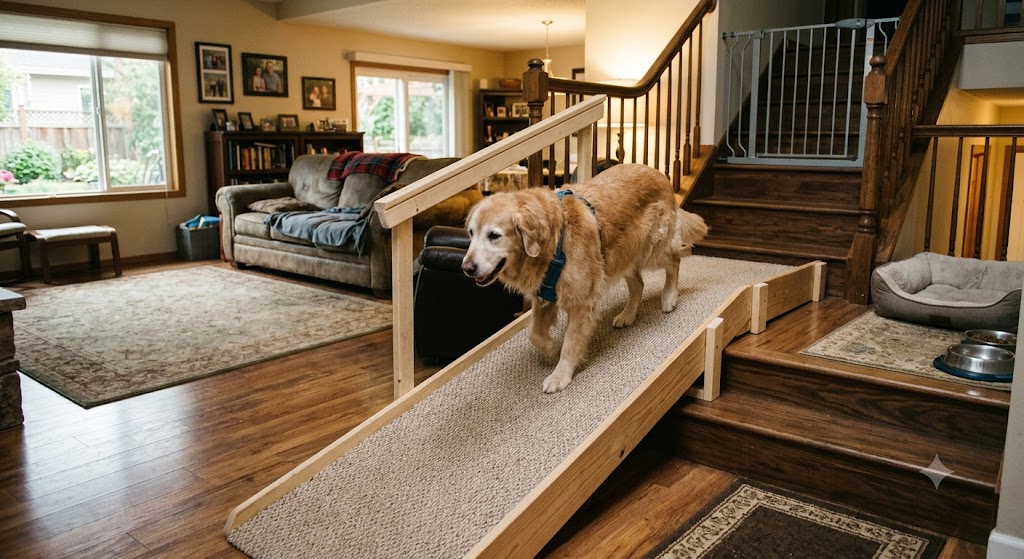
If you live in a two- or three-story home, your senior dog’s world is quietly shrinking. Not because you’ve locked them out, but because stairs that were once effortless have become painful, hallway floors have become skating rinks, and the bedroom upstairs now costs them more than it gives. The goal isn’t to confine your dog to a single room—it’s to redesign what already exists so they can keep living fully without constantly risking a fall or burning through energy reserves just navigating the house.
In this Guide
- 1 Do a Mobility Audit Before You Buy Anything
- 2 Stair Traction: The Non-Negotiable First Fix
- 3 Create Traction Corridors Between Key Destinations
- 4 Rethink Furniture Layout for Navigation, Not Aesthetics
- 5 Set Up Supported Rest Zones on Every Active Floor
- 6 Manage Doorway and Threshold Transitions
- 7 Build a Main-Floor Headquarters for Advanced Cases
- 8 Reassess Regularly—Mobility Changes Are Non-Linear
Do a Mobility Audit Before You Buy Anything
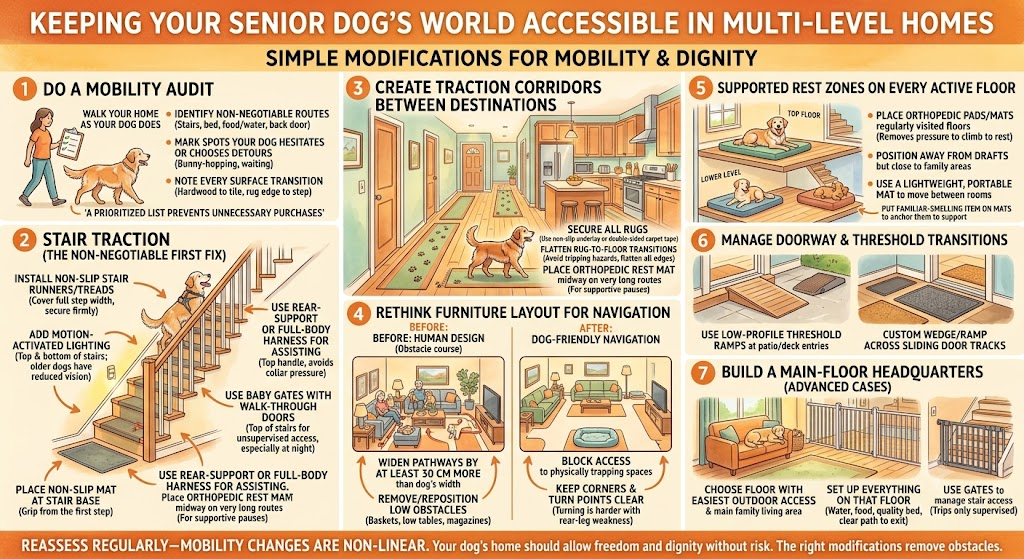
The most common mistake is purchasing gear before understanding where the real problems are. Walk your home as your dog does and note every transition, surface change, and height difference they encounter in a typical day.
- Identify the non-negotiable routes: stairs to the sleeping area, path from bed to back door, access to food and water.
- Mark spots where your dog already hesitates, bunny-hops, or chooses a detour—these are injury-risk areas that need addressing first.
- Note every surface transition: where hardwood meets tile, where a rug ends before a step begins, where a threshold raises the floor by even 2–3 cm.
This audit takes ten minutes and gives you a prioritized list. Without it, you end up buying rugs for the living room when the real danger is the uncarpeted stair landing.
Stair Traction: The Non-Negotiable First Fix
Bare wood, tile, or painted stairs are among the most serious mobility hazards in any home. Traction is the fix—not avoidance, unless your dog is truly beyond managing stairs at all.
- Install stair runners or individual non-slip stair treads covering the full width of each step, secured firmly so they don’t shift under weight. The leading edge of the step is where most slips begin.
- Add motion-activated lighting at the top and bottom of staircases. Older dogs often have reduced vision, and a dimly lit stair is harder to judge accurately even for a physically capable dog.
- Place a non-slip mat at the base of each staircase so your dog has grip from the first step off the landing, not just on the stairs themselves.
- Use baby gates with walk-through doors at the top of dangerous staircases to block unsupervised access, especially at night when cognitive and physical fatigue are highest.
When assisting on stairs, use a rear-support or full-body lift harness with a top handle rather than grabbing your dog’s collar or scooping under their belly. Collar pressure strains the neck and spine; a harness distributes your support across the whole body.
Create Traction Corridors Between Key Destinations
In multi-level homes, long uncarpeted hallways and open-plan kitchen areas can exhaust an arthritic dog before they even reach their destination. Every step on a slick surface demands extra muscular effort to stay stable—effort that a senior dog simply doesn’t have in reserve.
- Lay runners end-to-end along the full length of daily travel routes: bedroom corridor to stairs, base of stairs to back door, kitchen floor from bed to water bowl.
- Secure every rug with non-slip underlay or double-sided carpet tape. A rug that slides when your dog pushes off to stand is not just unhelpful—it’s a throw rug that throws your dog.
- Pay close attention to rug-to-floor transitions. A rug edge that curls or sits unevenly creates a trip point; use tape to flatten all edges or switch to low-profile runners.
- On particularly long routes, place an orthopedic rest mat midway if your dog tends to slow or stop—this gives them a supported pause rather than a collapse onto bare floor.
Furniture arrangements designed for humans often create obstacle courses for older dogs whose turning radius, depth perception, and spatial confidence are all diminishing.
- Widen pathways between sofas, chairs, and tables by at least the width of your dog plus 30 cm, so they can pass and turn without contorting their spine or hips.
- Remove or reposition anything low-profile that forces zigzag navigation: decorative baskets, magazine racks, low side tables, plant pots near doorways.
- Block access to spaces where your dog can become physically trapped—under beds with low clearance, behind large sofas, in closets—especially if cognitive changes are also present.
- Keep corners and turn points clear; these are where dogs with rear-leg weakness stumble most, as turning requires more neurological coordination than straight-line walking.
Set Up Supported Rest Zones on Every Active Floor
One of the highest-impact changes in a multi-level home costs almost nothing to implement: stop requiring your dog to climb stairs just to lie down somewhere comfortable near you.
- Place a supportive orthopedic pad or foldable mat on every floor your dog regularly visits—this removes the pressure to climb whenever they want to rest.
- Position beds away from drafts, vents, and high-traffic paths, but close enough to your main living areas that your dog doesn’t feel isolated by choosing to lie down.
- Keep a lightweight, portable mat you can move between rooms throughout the day so your dog can follow you without paying a physical toll each time.
- If your dog tends to sleep where you were last sitting, place a familiar-smelling item on the designated mat to anchor them to the supportive surface instead of the hard floor.
Manage Doorway and Threshold Transitions
Raised thresholds, sliding door tracks, and step-down transitions between rooms are minor irritants for a healthy dog and genuine stumbling hazards for a stiff or wobbly senior.
- Use low-profile threshold ramps at deck or patio entries where even a single raised step creates asymmetric leg loading mid-stride.
- Remove thick, padded door mats that bunch or shift underfoot; replace with thin, rubber-backed mats that stay flat and provide grip without adding height.
- For sliding glass doors, a custom wedge or transition ramp across the track allows your dog to cross without stepping over an obstacle with one paw higher than the other.
Build a Main-Floor Headquarters for Advanced Cases
For dogs whose mobility has declined to the point where stair use is genuinely risky even with modifications, the most practical solution is making one floor work as a complete living space.
- Choose the floor with the easiest outdoor access and your main family living area—this keeps your dog both safe and included rather than isolated.
- Set up everything your dog needs on that floor: water, food, a quality orthopedic bed, and a clear path to the outdoor exit.
- Use gates to manage stair access so upstairs trips happen only when supervised, not as independent daily routine.
- Reassess the setup every two to three months, as what works at early senior stage often needs adjusting as mobility changes further.
Reassess Regularly—Mobility Changes Are Non-Linear
The home modifications that work today may be inadequate in six months. Senior dog mobility doesn’t decline in a straight line; it often holds steady, then drops suddenly after illness, a weather change, or a painful episode.
- Repeat your mobility audit every season, watching specifically for new hesitation points or routes your dog has quietly started to avoid.
- Track how often you’re physically assisting on stairs or transitions—a steady increase is a clear signal that the current setup needs to be strengthened, not maintained.
- Bring your vet into the conversation at each check-up; changes in how your dog navigates your home are clinical information worth documenting, not just household observations.
The goal of all of this is simple: your senior dog should be able to get where they need to go with dignity and without daily risk. The right modifications remove the obstacles, not the freedom.